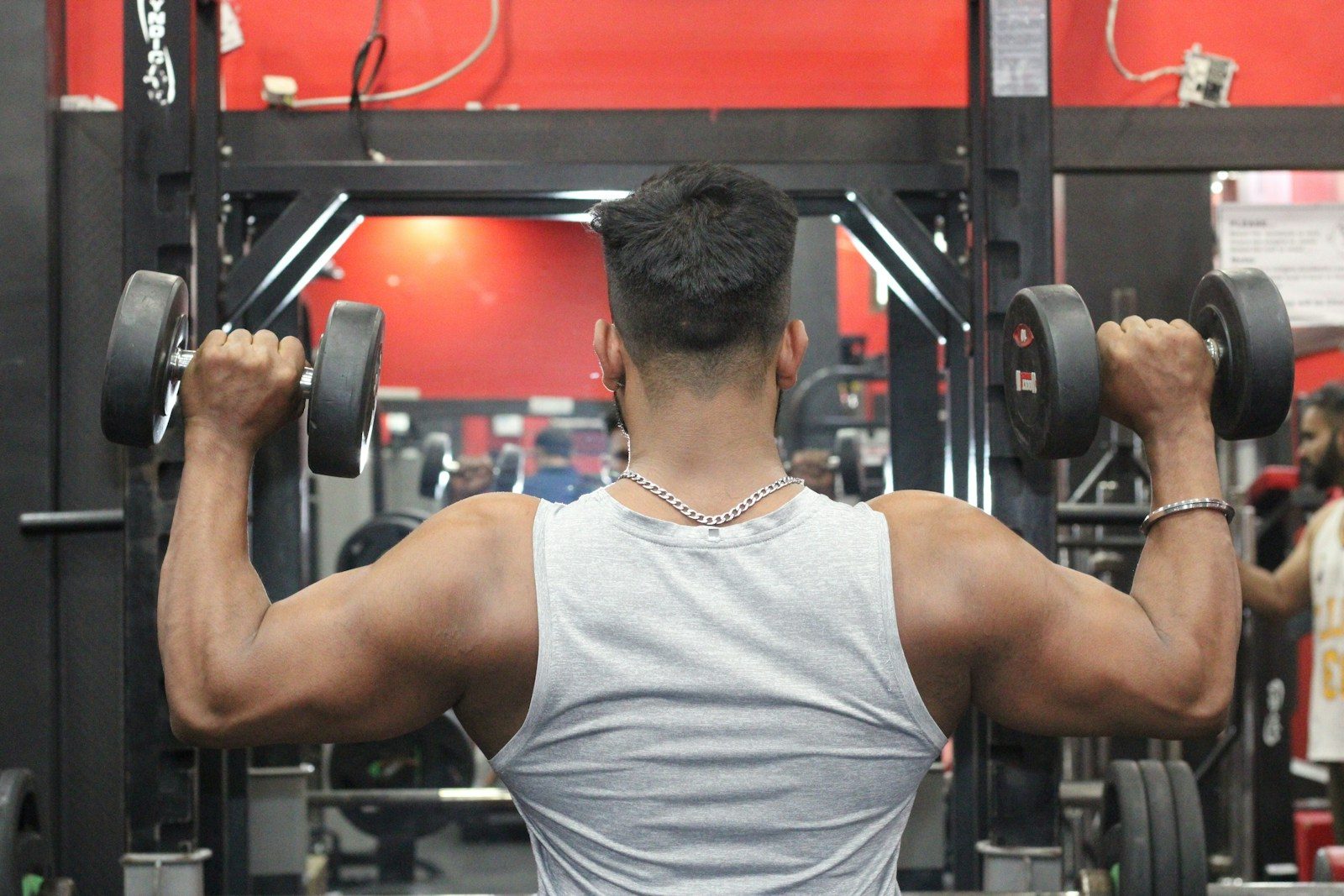
A dumbbell upper body workout can train your chest, back, shoulders, biceps, and triceps with only a pair of dumbbells and a stable bench or floor space. The routine below combines pressing, rowing, shoulder work, and direct arm exercises in one balanced session.
You can perform it at home or in a gym, and every bench-based movement has a no-bench alternative. You will also learn how to choose your weights, use proper form, organize the workout, and progress without making the program unnecessarily complicated.
The American College of Sports Medicine’s updated resistance-training guidance emphasizes consistency, appropriate effort, and regular training over complicated techniques. It also recognizes home-based resistance training as an effective option for improving strength and physical function.
Dumbbell Upper Body Workout at a Glance
Perform the exercises in the order shown. The larger chest, back, and shoulder movements come first because they require the most coordination and generally allow the greatest loads.
| Exercise | Main muscles worked | Sets and reps | Rest |
|---|---|---|---|
| Dumbbell chest press | Chest, front shoulders, triceps | 3 × 6–12 | 90–120 seconds |
| One-arm dumbbell row | Lats, upper back, rear shoulders, biceps | 3 × 8–12 per side | 90 seconds |
| Seated dumbbell shoulder press | Shoulders, triceps | 2–3 × 6–12 | 90–120 seconds |
| Dumbbell reverse fly | Rear shoulders, rhomboids, trapezius | 2 × 10–15 | 60–90 seconds |
| Dumbbell lateral raise | Middle deltoids | 2 × 10–15 | 60–90 seconds |
| Dumbbell hammer curl | Biceps, brachialis, forearms | 2 × 8–15 | 60–90 seconds |
| Dumbbell overhead triceps extension | Triceps | 2 × 8–15 | 60–90 seconds |
Most people can complete the full workout in approximately 35–50 minutes, depending on the number of sets and length of the rest periods.
Beginner starting point
For your first two to four weeks, perform two working sets of every exercise. Concentrate on repeatable technique rather than trying to use the heaviest possible dumbbells.
Recommended effort
Finish most sets with approximately one to three technically clean repetitions still possible. This is often called leaving one to three reps in reserve.
The set should feel challenging, but your final repetition should still resemble your first. You do not need to reach complete muscular failure on every set. ACSM’s 2026 position-stand summary reports that momentary failure is not consistently necessary for the average healthy adult.
Why This Dumbbell Upper Body Workout Works
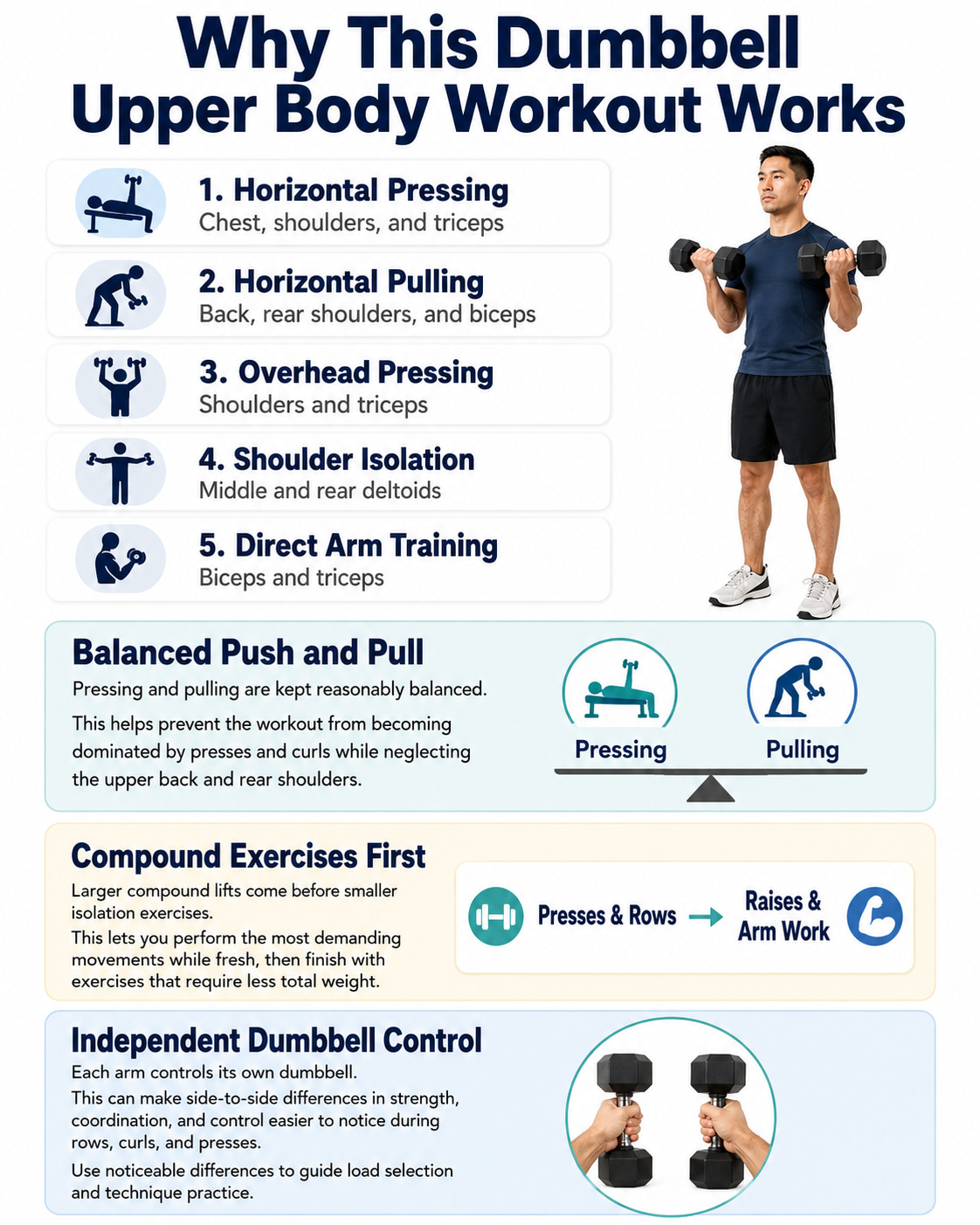
This routine covers the main upper-body movement patterns that dumbbells perform well:
- Horizontal pressing for the chest, shoulders, and triceps
- Horizontal pulling for the back, rear shoulders, and biceps
- Overhead pressing for the shoulders and triceps
- Shoulder isolation for the middle and rear deltoids
- Direct elbow flexion and extension for the biceps and triceps
Pressing and pulling are kept reasonably balanced. That matters because a routine made almost entirely from presses and curls can neglect the muscles across the upper back and rear shoulders.
The exercises also move from larger compound lifts to smaller isolation movements. This allows you to perform demanding exercises while fresh and finish with movements that need less total weight.
Dumbbells provide another practical benefit: each arm must control its own weight. This can make side-to-side differences easier to notice, especially during rows, curls, and presses. It does not mean both sides must always perform identically, but obvious differences can guide your load selection and technique work.
Muscles Worked
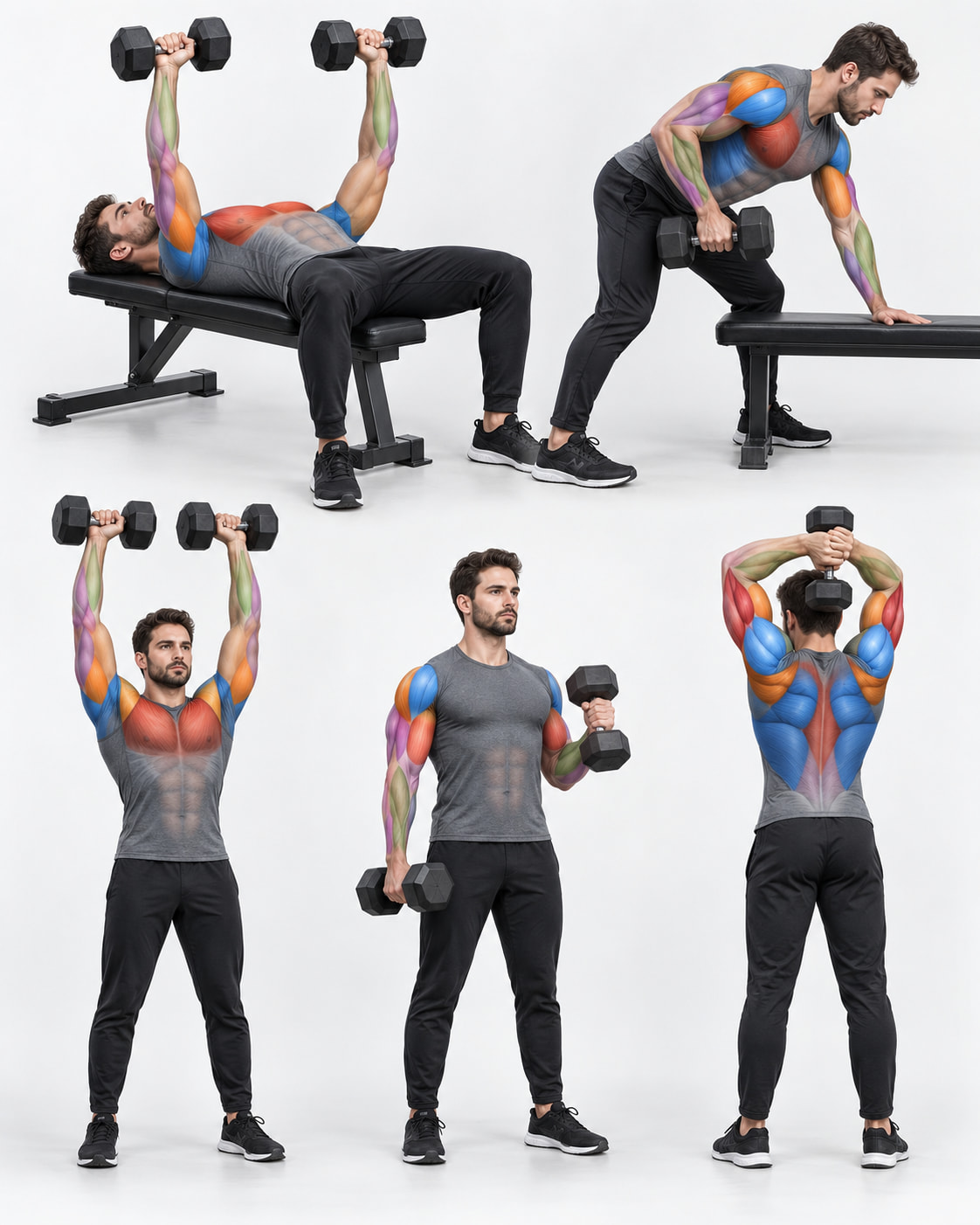
1. Chest
The pectoralis major produces much of the force during the dumbbell chest press. The front deltoids and triceps assist as you press the weights away from the chest.
2. Back
The one-arm row primarily trains the latissimus dorsi and other muscles responsible for pulling the upper arm toward the torso. The trapezius, rhomboids, rear deltoids, biceps, and forearms also contribute.
3. Shoulders
The shoulder press mainly trains the front and middle portions of the deltoids. Lateral raises emphasize the middle deltoids, while reverse flyes focus more on the rear deltoids and upper-back muscles.
3. Arms
Hammer curls train the biceps brachii, brachialis, and brachioradialis. Overhead extensions train the triceps, including the long head, which crosses the shoulder joint.
4. Forearms, grip, and core
Your hands and forearms stabilize the dumbbells throughout the workout. Your abdominal and lower-back muscles also work isometrically to control the torso during standing presses, rows, raises, and curls.
Equipment You Need
The complete routine requires:
- One pair of dumbbells or adjustable dumbbells
- A flat or adjustable exercise bench
- Enough clear space to move the dumbbells safely
A bench is helpful but not essential. You can use the floor for chest presses and a sturdy, non-rolling chair for supported rows.
Do not brace against furniture that can slide, fold, or tip. Check that adjustable dumbbells are securely locked before every set.
How to Choose the Right Dumbbell Weight
Different exercises usually require different weights. The dumbbells used for a chest press or row will normally be heavier than those used for a lateral raise or reverse fly.
Choose a weight that allows you to reach the bottom of the prescribed repetition range without swinging, shortening the movement, or changing your body position.
For example, when the range is 8–12 repetitions:
- The weight is probably too heavy if you cannot perform eight controlled repetitions.
- The weight is appropriate if you can perform 8–12 challenging repetitions with stable form.
- The weight may be too light if you can easily exceed 12 repetitions with several more still available.
Do not increase the weight simply because you completed one good set. First reach the top of the rep range across every working set while maintaining control.
Upper Body Warm-Up
The Mayo Clinic weight-training guidance recommends warming up with five to ten minutes of brisk walking or another aerobic activity before lifting. It also advises using controlled repetitions and reducing the weight when good form cannot be maintained.
Use this simple warm-up:
- Perform five to ten minutes of brisk walking, easy cycling, or marching in place.
- Complete eight to ten slow arm circles in each direction.
- Perform eight to ten controlled shoulder-blade movements without weight.
- Complete one or two light practice sets of the chest press and row.
The warm-up should prepare you to train without tiring your upper body before the working sets begin.
Complete Dumbbell Upper Body Workout
1. Dumbbell Chest Press
Best for: Building horizontal pressing strength through the chest, shoulders, and triceps.
Muscles worked: Pectoralis major, anterior deltoids, and triceps.
Equipment needed: Two dumbbells and a flat bench. Use the floor when a bench is unavailable.
Sets, reps, and rest: Perform 3 sets of 6–12 repetitions. Rest 90–120 seconds.
How to do it
- Sit at the end of the bench with one dumbbell resting securely on each thigh.
- Guide the dumbbells toward your chest as you lie back.
- Plant your feet firmly and keep your head, upper back, and hips supported.
- Position the dumbbells over the chest with straight wrists and palms facing forward or slightly inward.
- Lower the dumbbells under control until you reach a comfortable depth.
- Keep your elbows below the wrists without flaring them directly out to the sides.
- Press the dumbbells upward while exhaling.
- Finish with the weights balanced over the chest rather than over the face.
The ACE dumbbell chest press guide also emphasizes stable contact with the bench, neutral wrists, and a controlled lowering phase.
Common mistakes: Avoid bouncing at the bottom, lifting the hips, excessively arching the lower back, bending the wrists, or allowing one dumbbell to move faster than the other. Do not force the elbows below a comfortable depth.
Progression or regression: Progress by adding repetitions and then increasing the weight. Regress to a dumbbell floor press, which shortens the lowering range because the upper arms stop against the floor.
Coaching cue: Keep your wrists stacked over your elbows.
2. One-Arm Dumbbell Row
Best for: Building the lats and upper back while training each side independently.
Muscles worked: Latissimus dorsi, rhomboids, trapezius, rear deltoids, biceps, brachialis, and forearms.
Equipment needed: One dumbbell and a bench or sturdy support.
Sets, reps, and rest: Perform 3 sets of 8–12 repetitions per side. Rest approximately 90 seconds after completing both sides.
How to do it
- Place one hand and the same-side knee on a bench.
- Hold the dumbbell in the opposite hand with the arm extended toward the floor.
- Brace your abdomen and keep your head aligned with your spine.
- Keep your shoulders and hips facing the floor.
- Pull the elbow back and slightly toward your hip.
- Stop when you cannot pull farther without rotating your torso or shrugging.
- Lower the dumbbell slowly until the arm is extended again.
- Complete all repetitions before switching sides.
The ACE single-arm row instructions emphasize bracing the torso, maintaining a neutral spine, keeping the working arm close to the body, and avoiding trunk rotation.
Common mistakes: Do not twist the torso, jerk the dumbbell from the floor, pull the weight toward the shoulder, or round the lower back. A heavy dumbbell is not useful if momentum performs most of the repetition.
Progression or regression: Use a lighter weight and increase bench support as a regression. Progress by adding load, pausing briefly at the top, or using a controlled two- to three-second lowering phase.
Coaching cue: Pull your elbow toward your back pocket.
3. Seated Dumbbell Shoulder Press
Best for: Developing overhead pressing strength and building the front and middle deltoids.
Muscles worked: Anterior deltoids, middle deltoids, and triceps.
Equipment needed: Two dumbbells and a back-supported bench or stable chair.
Sets, reps, and rest: Perform 2–3 sets of 6–12 repetitions. Rest 90–120 seconds.
How to do it
- Sit with your feet flat and your back supported.
- Hold the dumbbells around shoulder height with straight wrists.
- Use a palms-forward grip or turn the palms slightly inward if that feels more comfortable.
- Brace your abdomen and keep your ribs controlled.
- Press both dumbbells overhead without leaning backward.
- Finish with the weights balanced over the shoulders.
- Lower the dumbbells slowly to a comfortable position near shoulder height.
- Reset your torso before beginning the next repetition.
The ACE seated overhead press guide recommends firm foot placement, core bracing, neutral wrists, controlled lowering, and avoiding excessive lower-back arching.
Common mistakes: Avoid driving the ribs forward, arching the lower back, pressing one side faster, bending the wrists, or dropping the dumbbells quickly toward the shoulders.
Progression or regression: Regress by using lighter dumbbells, a neutral grip, or one arm at a time. Progress by increasing repetitions, adding weight, or performing the movement standing once you can control your torso.
Coaching cue: Press upward without letting your ribs follow the dumbbells.
4. Dumbbell Reverse Fly
Best for: Training the rear shoulders and upper back after the heavier presses and rows.
Muscles worked: Posterior deltoids, rhomboids, and middle trapezius.
Equipment needed: Two light dumbbells and an incline bench. A bench is optional.
Sets, reps, and rest: Perform 2 sets of 10–15 repetitions. Rest 60–90 seconds.
How to do it
- Set an adjustable bench to a moderate incline and lie chest-down against it.
- Plant your feet and allow the dumbbells to hang beneath your shoulders.
- Face your palms toward each other and keep a soft bend in the elbows.
- Raise the dumbbells outward in a wide arc.
- Keep the elbows and hands moving together.
- Stop when the upper arms are approximately level with the torso or when your controlled range ends.
- Lower the dumbbells slowly to the starting position.
The ACE incline reverse fly guide teaches a chest-supported setup, light elbow bend, controlled outward raise, and stable torso position.
Common mistakes: Using too much weight often turns the movement into a row or a shrug. Avoid swinging, lifting the chest away from the bench, straightening and bending the elbows repeatedly, or forcing the arms too far behind the torso.
Progression or regression: The chest-supported version is usually the easiest to control. Without a bench, hinge at the hips with a neutral spine and perform the same arm movement. Progress by adding a brief pause at the top before increasing the weight.
Coaching cue: Move the arms wide, not backward.
5. Dumbbell Lateral Raise
Best for: Adding direct training for the middle deltoids.
Muscles worked: Middle deltoids, with assistance from the upper trapezius and other shoulder stabilizers.
Equipment needed: Two light dumbbells.
Sets, reps, and rest: Perform 2 sets of 10–15 repetitions. Rest 60–90 seconds.
How to do it
- Stand with your feet stable and the dumbbells beside your thighs.
- Keep a small bend in your elbows and your wrists straight.
- Brace your torso without leaning backward.
- Raise the arms outward and slightly forward rather than directly behind the body.
- Lead with the elbows while keeping the hands and elbows at a similar height.
- Stop around shoulder height or earlier if that is your comfortable range.
- Lower the dumbbells slowly until they return to your sides.
The ACE lateral raise instructions emphasize a stable torso, neutral wrists, controlled lifting, and stopping around shoulder level.
Common mistakes: Avoid swinging through the knees, shrugging the shoulders, lifting the hands much higher than the elbows, bending the wrists, or using a weight that prevents a controlled descent.
Progression or regression: Regress by using lighter dumbbells or performing the exercise seated. Progress with additional repetitions, a slower lowering phase, or a small weight increase.
Coaching cue: Reach outward rather than trying to lift the dumbbells as high as possible.
6. Dumbbell Hammer Curl
Best for: Training the elbow flexors and forearms with a neutral grip.
Muscles worked: Biceps brachii, brachialis, brachioradialis, and forearm muscles.
Equipment needed: Two dumbbells.
Sets, reps, and rest: Perform 2 sets of 8–15 repetitions. Rest 60–90 seconds.
How to do it
- Stand tall with the dumbbells beside your thighs.
- Face your palms toward your body and keep your wrists straight.
- Brace your abdomen and keep your upper arms close to your sides.
- Bend your elbows and curl the dumbbells toward the fronts of your shoulders.
- Stop before the elbows drift forward.
- Lower the dumbbells under control until the arms are comfortably extended.
- Perform both arms together or alternate sides.
The ACE hammer curl guide recommends maintaining a neutral grip, stable torso, straight wrists, and stationary elbows throughout the movement.
Common mistakes: Avoid leaning backward, swinging the dumbbells, pushing the elbows forward, shrugging, bending the wrists, or dropping quickly through the lowering phase.
Progression or regression: Perform the movement seated or one arm at a time when learning the technique. Progress by reaching the top of the rep range before increasing the weight.
Coaching cue: Move the forearms while keeping the upper arms quiet.
7. Dumbbell Overhead Triceps Extension
Best for: Training the triceps through overhead elbow extension.
Muscles worked: All three heads of the triceps, with particular involvement from the long head.
Equipment needed: One dumbbell.
Sets, reps, and rest: Perform 2 sets of 8–15 repetitions. Rest 60–90 seconds.
How to do it
- Sit or stand in a stable position with your abdomen braced.
- Hold one dumbbell securely with both hands.
- Press the dumbbell overhead and keep your wrists firm.
- Position the upper arms close to your head without forcing them inward.
- Bend the elbows and lower the dumbbell behind your head.
- Stop when you reach a comfortable stretch or before the upper arms begin moving excessively.
- Straighten the elbows to return the dumbbell overhead.
- Keep your head neutral and avoid hitting the dumbbell against it.
Use only a dumbbell design that you can hold securely. The ACE triceps extension guide emphasizes core bracing, controlled elbow movement, stable upper arms, and avoiding excessive changes in head or torso position.
Common mistakes: Avoid arching the lower back, flaring the ribs, allowing the elbows to spread excessively, moving the upper arms backward, or lowering the dumbbell farther than your shoulders comfortably allow.
Progression or regression: Regress by using a lighter dumbbell, sitting against a backrest, or reducing the range of motion. Progress by adding repetitions and then increasing the load.
Coaching cue: Bend and straighten the elbows without moving your ribs.
How to Structure the Workout
Straight-set option
Complete every set of one exercise before moving to the next. This is the simplest setup and makes it easier to track weights, repetitions, and technique.
For example:
- Complete all chest press sets.
- Rest as prescribed.
- Complete all one-arm row sets.
- Continue through the routine in order.
This is the best starting structure for beginners.
Superset option
Intermediate lifters can pair opposing or noncompeting exercises to save time:
- Dumbbell chest press with one-arm dumbbell row
- Seated shoulder press with dumbbell reverse fly
- Hammer curl with overhead triceps extension
Perform one set of the first exercise, move to the second exercise, and then rest for 60–90 seconds before repeating the pair.
Keep the lateral raise separate or add it after the final pair. Supersets should save time without turning controlled strength work into rushed cardio.
Short 20–25-minute option
When time is limited, prioritize:
- Dumbbell chest press
- One-arm dumbbell row
- Seated dumbbell shoulder press
- One accessory exercise
Perform 2–3 sets of each. Alternate the accessory exercise between reverse flyes, lateral raises, curls, and triceps extensions across different sessions.
No-Bench Dumbbell Upper Body Workout Modifications
| Original exercise | No-bench alternative |
|---|---|
| Dumbbell chest press | Dumbbell floor press |
| Bench-supported one-arm row | Row with one hand supported on a sturdy chair |
| Seated shoulder press | Standing shoulder press or seated press on a stable chair |
| Chest-supported reverse fly | Hip-hinged dumbbell reverse fly |
| Dumbbell lateral raise | No change needed |
| Dumbbell hammer curl | No change needed |
| Overhead triceps extension | Standing variation |
A no-bench workout should still use the same basic sets, repetitions, rest periods, and progression method.
When using a chair for support, make sure it is stable, does not have wheels, and cannot slide across the floor.
Can You Do the Workout With One Dumbbell?
Yes. Perform one side at a time for rows, shoulder presses, lateral raises, and curls.
For the chest movement, use a single-arm dumbbell floor press. Keep your feet planted and resist the urge to rotate your torso toward the working arm.
The overhead triceps extension already uses one dumbbell. Complete the same number of repetitions on both sides whenever an exercise is performed unilaterally.
One-dumbbell training takes longer, but it can be effective when you control your body position and apply the same progression rules.
How Often Should You Do This Workout?
Perform the routine twice per week on nonconsecutive days for a practical starting schedule.
Examples include:
- Monday and Thursday
- Tuesday and Friday
- Wednesday and Saturday
The current Physical Activity Guidelines for Americans recommend muscle-strengthening activity on at least two days each week. ACSM’s 2026 resistance-training update also emphasizes training all major muscle groups at least twice weekly.
You do not need to perform this exact session twice if other workouts already train the same muscles. Count all pressing, rowing, shoulder, and arm work when evaluating your weekly training.
Avoid repeating a demanding upper-body workout on consecutive days. Allow time for the trained muscles to recover before loading them heavily again.
How to Progress the Routine
Use a simple double-progression method.
Step 1: Choose a suitable weight
Select a dumbbell that allows you to reach the bottom of the target rep range with clean form.
For a 6–12-repetition range, that means completing at least six controlled repetitions.
Step 2: Add repetitions gradually
Keep the same dumbbell weight and try to add one repetition when possible.
Your chest press progression might look like this:
- Week 1: 10, 9, 8 repetitions
- Week 2: 10, 10, 9 repetitions
- Week 3: 11, 10, 10 repetitions
- Week 4: 12, 12, 12 repetitions
Progress will not always occur every workout. Repeat the same performance when necessary instead of forcing extra repetitions with poor form.
Step 3: Increase the weight
Once every set reaches the top of the range with one to three repetitions still available, move to the next manageable dumbbell.
Your repetitions will probably return to the lower end of the range. Build them up again before making another increase.
Step 4: Progress when weight jumps are too large
When the next dumbbell is too heavy, progress by:
- Adding one repetition
- Slowing the lowering phase
- Adding a brief pause
- Improving range of motion
- Adding one set to a priority exercise
- Performing one arm at a time
Change one variable at a time so you can identify what is actually improving.
Common Dumbbell Upper Body Workout Mistakes
Using the same weight for every exercise
Your back and chest can usually handle more resistance than your middle or rear deltoids. Choose the load separately for each movement.
Starting with isolation exercises
Heavy curls and lateral raises can tire the arms and shoulders before the main presses and rows. Perform the larger compound exercises first unless you have a specific reason to prioritize an accessory movement.
Performing more pressing than pulling
Chest and shoulder presses are important, but rows and reverse flyes help keep the workout balanced. Do not repeatedly skip the back exercises while completing every pressing set.
Rushing the repetitions
Fast, uncontrolled repetitions make it difficult to maintain joint position and determine whether the target muscles are doing the work. Lift deliberately and control the lowering phase.
Training to failure on every set
Constant failure can reduce repetition quality and make later exercises less productive. Most sets should stop when another one to three clean repetitions would still be possible.
Resting too little
Begin the next set when you can maintain the planned weight and technique. If your repetitions fall sharply because you are still breathing heavily, extend the rest period.
Failing to track performance
Record the dumbbell weight, repetitions, and sets. Without a training log, it is difficult to know whether you are gradually doing more work.
Safety Considerations
Inspect the dumbbells and bench before starting. Adjustable plates should be secure, the floor should be clear, and the bench should not move during pressing or rowing.
Use controlled breathing. Exhale during the lifting portion and inhale during the lowering portion rather than holding your breath through the entire repetition.
Normal muscular effort and temporary fatigue are expected. Sharp pain, numbness, dizziness, chest pain, or unusual symptoms are not signals to push through. Stop the exercise and seek appropriate professional guidance if these occur.
Anyone returning after an injury, managing a medical condition, or uncertain about exercise technique should consult an appropriate healthcare or qualified fitness professional before using heavy resistance.
Frequently Asked Questions
Can dumbbells train the entire upper body?
Dumbbells can train the major muscles of the chest, back, shoulders, arms, forearms, and upper-body stabilizers. Rows provide the main pulling movement in a dumbbell-only routine.
A separate vertical-pulling movement can add variety when other equipment is available, but it is not necessary to benefit from this workout.
Is a bench required?
No. Replace the dumbbell chest press with a floor press and perform the reverse fly from a supported hip-hinge position. A sturdy chair can provide support for one-arm rows and seated presses.
What dumbbell weight should a beginner use?
There is no single correct starting weight. Choose a load that allows the bottom of the prescribed rep range with stable technique and approximately two clean repetitions still possible.
Use lighter dumbbells for raises and reverse flyes than for rows and presses.
Is this workout suitable for muscle growth?
It can support muscle growth when the sets are challenging, weekly training is consistent, and weights or repetitions increase over time. Adequate food intake, protein, sleep, and recovery also affect results.
Lifters specifically prioritizing muscle growth may eventually need more weekly sets for individual muscle groups than the beginner version provides.
How long should the workout take?
The full routine generally takes about 35–50 minutes. Performing two sets instead of three, using controlled supersets, or choosing the short version can reduce the session length.
Can beginners perform this workout?
Yes. Beginners should start with two sets per exercise, use manageable weights, and practice each setup before increasing resistance.
It is better to complete fewer exercises correctly than to rush through the full routine with unstable form.
Can I train my upper body on consecutive days?
Avoid performing the complete routine on consecutive days. Space sessions apart so the chest, back, shoulders, and arms have time to recover.
You can train another area of the body or perform light general activity between upper-body sessions.
Conclusion
A well-structured dumbbell upper body workout does not require dozens of exercises. A chest press, row, shoulder press, rear-shoulder movement, lateral raise, curl, and triceps extension provide a practical combination of pushing, pulling, and direct arm training.
Start with manageable weights, leave a few clean repetitions available, and record each session. Add repetitions before increasing the load, and let consistent training—not constant exercise changes—drive your progress.
References
- American College of Sports Medicine: Updated Resistance Training Guidelines
- U.S. Department of Health and Human Services: Physical Activity Guidelines for Americans
- Mayo Clinic: Weight Training Technique and Safety
- American Council on Exercise compound-exercise guides: Chest Press, Single-Arm Row, and Seated Overhead Press
- American Council on Exercise accessory-exercise guides: Incline Reverse Fly, Lateral Raise, Hammer Curl, and Triceps Extension
This content is for informational purposes only and is not a substitute for medical advice.