The dumbbell Romanian deadlift is a hip-hinge exercise that primarily trains the hamstrings and glutes while the core and back muscles keep the trunk stable. To perform it correctly, push your hips backward with a slight bend in your knees, keep the dumbbells close to your legs, and stop the descent when you feel a strong but controlled hamstring stretch.

Unlike a conventional deadlift, the dumbbell Romanian deadlift begins from a standing position rather than with the weights resting on the floor. This guide explains proper form, muscles worked, common mistakes, beginner modifications, progressions, and practical ways to include the exercise in a workout. The technique follows guidance from the National Academy of Sports Medicine and the American Council on Exercise.
What Is a Dumbbell Romanian Deadlift?
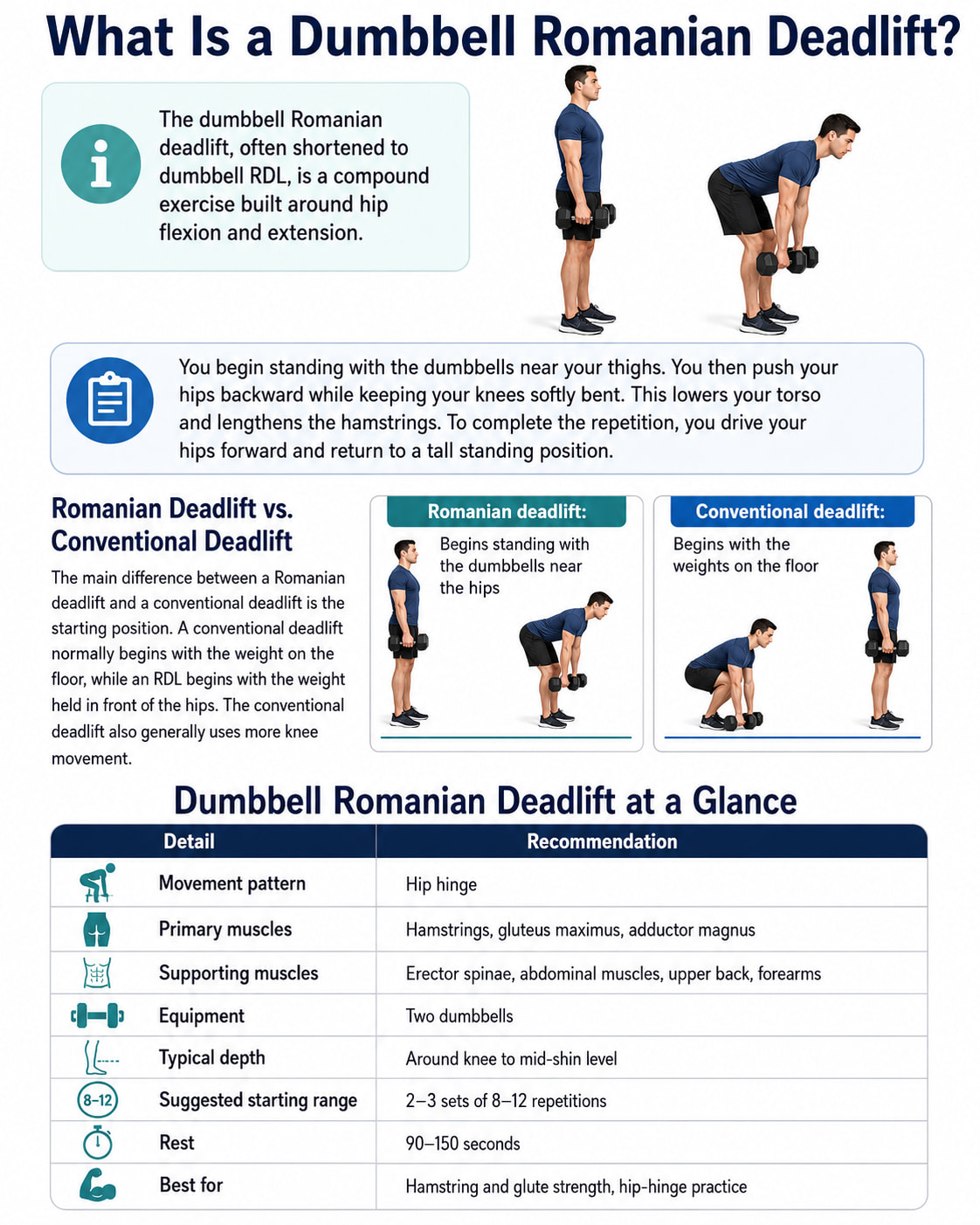
The dumbbell Romanian deadlift, often shortened to dumbbell RDL, is a compound exercise built around hip flexion and extension.
You begin standing with the dumbbells near your thighs. You then push your hips backward while keeping your knees softly bent. This lowers your torso and lengthens the hamstrings. To complete the repetition, you drive your hips forward and return to a tall standing position.
The main difference between a Romanian deadlift and a conventional deadlift is the starting position. A conventional deadlift normally begins with the weight on the floor, while an RDL begins with the weight held in front of the hips. The conventional deadlift also generally uses more knee movement.
Dumbbell Romanian Deadlift at a Glance
| Detail | Recommendation |
|---|---|
| Movement pattern | Hip hinge |
| Primary muscles | Hamstrings, gluteus maximus, adductor magnus |
| Supporting muscles | Erector spinae, abdominal muscles, upper back, forearms |
| Equipment | Two dumbbells |
| Typical depth | Around knee to mid-shin level |
| Suggested starting range | 2–3 sets of 8–12 repetitions |
| Rest | 90–150 seconds |
| Best for | Hamstring and glute strength, hip-hinge practice |
How to Do the Dumbbell Romanian Deadlift
Best for: Strengthening the hamstrings and glutes while learning a controlled hip hinge.
Muscles worked: Hamstrings, gluteus maximus, adductor magnus, erector spinae, core, trapezius, and forearms.
Equipment needed: Two dumbbells. Beginners can start with one dumbbell held in both hands.
Sets, reps, and rest: Begin with 2–3 sets of 8–12 controlled repetitions. Rest for 90–150 seconds between sets.
Step-by-Step Instructions
- Stand with your feet approximately hip-width apart. Hold one dumbbell in each hand with your arms extended and your palms facing your thighs.
- Create a stable starting position. Keep your feet firmly planted, straighten your wrists, brace your abdomen, and hold your shoulders in a comfortable position away from your ears.
- Soften your knees. Use a small knee bend, but do not begin squatting downward.
- Push your hips backward. Imagine reaching your hips toward the wall behind you as your torso begins to lean forward.
- Keep the dumbbells close. Allow the weights to travel down the front or slightly outside your thighs. They should remain close to your legs rather than swinging forward.
- Stop at your controlled limit. End the descent when you feel clear tension through the backs of your thighs and can no longer push your hips farther back without rounding your back. For many people, this occurs around knee to mid-shin height.
- Return to standing. Press your feet into the floor and drive your hips forward. Finish standing tall with your ribs positioned over your pelvis.
- Begin the next repetition under control. Do not bounce out of the bottom position or use momentum.
Coaching cue: Push your hips toward the wall behind you while keeping the dumbbells close to your legs.
Maintain a slight knee bend and controlled spinal position while pushing the hips backward. Lower only until you feel clear tension in the backs of your thighs rather than forcing the dumbbells toward the floor.
How Low Should You Go?
You do not need to lower the dumbbells to the floor.
The appropriate depth depends on your hip mobility, hamstring tolerance, limb proportions, and ability to maintain control. One person may reach mid-shin level comfortably, while another may need to stop just below the knees.
End the descent when:
- You feel strong tension in the hamstrings.
- Your hips can no longer travel backward.
- Your knees are still only slightly bent.
- The dumbbells remain close to your legs.
- Your back and neck remain controlled.
Stop sooner when your lower back begins to round, your knees move farther forward, or the dumbbells drift away from you. A deeper repetition is not better when it changes the movement from a controlled hip hinge into a squat or rounded-back reach.
What Should a Dumbbell RDL Feel Like?
You should mainly feel the exercise through the backs of your thighs and your glutes. Your abdominal and back muscles should work to keep your trunk stable, while your hands and forearms hold the dumbbells.
You may notice some muscular effort in the lower back because the erector spinae help maintain trunk position. However, the lower back should not feel like the only area doing the work.
When lower-back fatigue consistently appears before hamstring or glute fatigue, try:
- Reducing the dumbbell weight.
- Shortening the range of motion.
- Keeping the dumbbells closer to your legs.
- Bracing before each repetition.
- Practicing the hip hinge without weight.
- Checking that your hips move backward instead of downward.
Stop the exercise if you experience sharp pain, numbness, or unusual symptoms.
Dumbbell Romanian Deadlift Muscles Worked
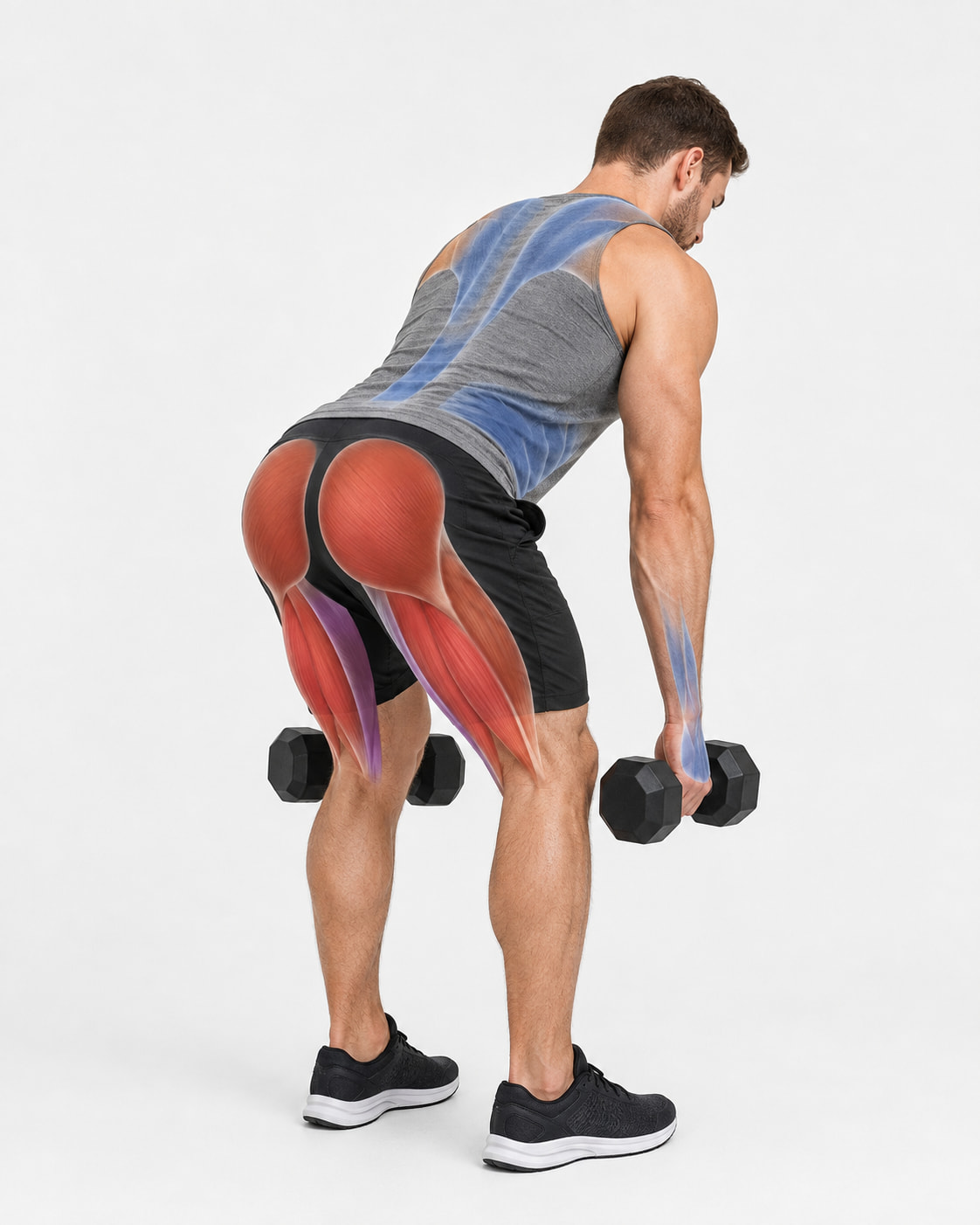
Hamstrings
The hamstrings include the biceps femoris, semitendinosus, and semimembranosus. Most of these muscles cross the hip and help extend it, making them major contributors when you return from the hinged position to standing.
During the lowering phase, the hamstrings lengthen under tension as the hips move backward. The NCBI Bookshelf overview of hamstring anatomy explains that the hamstrings contribute to both hip extension and knee flexion.
Gluteus Maximus
The gluteus maximus helps extend the hips as you stand. It works with the hamstrings to bring the torso and hips back into an upright position.
You do not need to forcefully squeeze the glutes or push the hips far forward at the top. Simply finish with your hips underneath your torso.
Adductor Magnus
The adductor magnus is commonly described as an inner-thigh muscle, but part of it also assists with hip extension. It contributes alongside the hamstrings and glutes during the upward phase of the RDL.
Erector Spinae and Core Muscles
The erector spinae and deeper trunk muscles help maintain the position of the spine while the hips move. The abdominal muscles also create tension to resist excessive spinal movement.
These muscles should stabilize the torso rather than repeatedly rounding and extending the lower back.
Upper Back, Hands, and Forearms
The trapezius and other upper-back muscles help control the shoulder girdle while the dumbbells hang beneath the arms. The muscles of the hands and forearms maintain your grip.
A PLOS ONE systematic review of muscle activity during deadlift variations found meaningful hamstring involvement during the Romanian deadlift. However, results varied between studies, so muscle-activation findings should not be used to claim that the RDL is always the single best hamstring exercise.
Benefits of Dumbbell Romanian Deadlifts
Builds Hamstring and Glute Strength
The dumbbell RDL directly trains hip extension, allowing the hamstrings, glutes, and adductor magnus to work together.
Trains the Hamstrings Through a Lengthened Position
Pushing the hips backward lengthens the hamstrings while they control the weight. This makes the exercise a useful addition to a program that also includes knee-flexion exercises such as leg curls.
Teaches the Hip-Hinge Pattern
The RDL helps you practice moving through the hips while keeping your trunk controlled. This movement pattern is also used in conventional deadlifts, good mornings, kettlebell swings, and many everyday lifting tasks.
Requires Limited Equipment
You only need a pair of dumbbells and enough space to hinge safely. This makes the movement practical for home and gym workouts.
Strengthens Grip and Trunk Stability
Holding the dumbbells challenges the hands and forearms, while the trunk muscles work to maintain alignment throughout each repetition.
Hip-hinge development, posterior-chain strength, trunk stability, and grip strength are among the main practical benefits of the Romanian deadlift.
Common Dumbbell Romanian Deadlift Mistakes
1. Turning the Exercise Into a Squat
The mistake: The knees move forward and the hips drop downward.
Why it matters: This changes the movement from a hip-dominant hinge into a more knee-dominant squat.
How to fix it: Soften your knees once, then focus on moving your hips backward. Your shins should remain approximately vertical.
2. Rounding the Back to Reach Lower
The mistake: The upper or lower back rounds near the bottom of the repetition.
Why it happens: The weight may be too heavy, or you may be forcing a range of motion you cannot control.
How to fix it: Reduce the load and stop the descent sooner. The dumbbells do not need to reach your ankles or the floor.
3. Locking the Knees Completely
The mistake: The legs remain rigidly straight throughout the exercise.
Why it matters: A standard dumbbell RDL uses a small knee bend. Completely locked knees may make it harder to control the hinge comfortably.
How to fix it: Unlock your knees slightly before pushing your hips backward, then maintain approximately the same knee angle.
4. Bending the Knees More During the Descent
The mistake: You begin with soft knees but continue bending them as the weights move down.
How to fix it: Think about keeping your knees in place while your hips travel backward. Stop before the movement becomes a squat.
5. Letting the Dumbbells Drift Forward
The mistake: The weights move several inches away from your thighs and shins.
Why it matters: This makes the dumbbells more difficult to control and may cause your lower back to fatigue sooner.
How to fix it: Keep your arms long and guide the dumbbells close to your legs throughout the repetition.
6. Looking Straight Ahead at the Bottom
The mistake: You lift your chin to watch yourself in a mirror while your torso is angled toward the floor.
How to fix it: Allow your head to follow your torso. Look at the floor several feet in front of you rather than forcing your eyes forward.
7. Moving Too Quickly
The mistake: You drop into the bottom position and bounce back up.
How to fix it: Lower the dumbbells for approximately two to three seconds. Pause briefly if necessary, then return to standing under control.
8. Leaning Back at the Top
The mistake: You force your hips forward and excessively arch your lower back.
How to fix it: Finish tall with your hips, ribs, and shoulders stacked. Once you are standing upright, the repetition is complete.
Rounding the back, bending the knees excessively, using momentum, allowing the weights to drift away, and selecting a load that disrupts alignment are among the main errors to avoid.
How to Choose the Right Dumbbell Weight
Start with a load that allows you to learn the hinge without struggling to hold your posture.
A suitable weight should let you:
- Complete every repetition without rounding your back.
- Keep the dumbbells close to your legs.
- Maintain approximately the same knee bend.
- Control the lowering phase.
- Feel the hamstrings and glutes working.
- Finish with approximately two or three good repetitions remaining.
The final repetitions should feel challenging, but the weight should not pull you out of position.
Beginners can hold one light dumbbell vertically with both hands in front of the thighs. Progress to two dumbbells after you can complete 10–15 controlled bodyweight or lightly loaded hip hinges.
Increase the weight by the smallest available amount when you can reach the top of your repetition range across every set without changing your technique.
Dumbbell Romanian Deadlift Sets, Reps, and Rest
The best repetition range depends on your experience and training goal.
| Goal | Sets | Repetitions | Rest | Suggested effort |
|---|---|---|---|---|
| Learning the movement | 2–3 | 8–10 | 90–120 seconds | 3–4 reps remaining |
| Building muscle | 3–4 | 8–12 | 90–180 seconds | 1–3 reps remaining |
| Strength emphasis | 3–4 | 6–8 | 2–3 minutes | 2–3 reps remaining |
| Accessory exercise | 2–3 | 10–15 | 60–120 seconds | 2–3 reps remaining |
These are starting ranges rather than fixed rules. Rest long enough to maintain your hip hinge, grip, and repetition quality.
For most readers, using the dumbbell RDL once or twice per week is sufficient. The total amount should account for other exercises that train the hamstrings and glutes, including deadlifts, hip thrusts, leg curls, lunges, and squats.
The American College of Sports Medicine emphasizes consistency, individualization, and adjusting training load and volume to the goal. Its resistance-training guidance also explains that training every set to complete muscular failure is not necessary for the average healthy adult.
Dumbbell Romanian Deadlift Regressions
Wall Hip Hinge
Stand several inches in front of a wall with your back facing it. Push your hips backward until they gently touch the wall, then return to standing.
Move slightly farther from the wall as your control improves. This teaches backward hip movement without adding weight.
Bodyweight Romanian Deadlift
Cross your arms over your chest or place your hands on your hips. Practice pushing the hips backward while maintaining soft knees and a controlled trunk.
Single-Dumbbell Romanian Deadlift
Hold one dumbbell with both hands in front of your thighs. This reduces the total load and may make the movement easier to coordinate.
Reduced-Range Dumbbell RDL
Lower the dumbbells only to knee level or another depth you can control. Gradually increase the range as your hinge improves.
Learn unloaded hip flexion and extension before adding substantial external resistance.
Dumbbell Romanian Deadlift Progressions
Heavier Dumbbell RDL
Increase the load gradually while keeping the same range, knee position, and movement speed.
Tempo Dumbbell RDL
Take three seconds to lower the dumbbells. This progression increases the difficulty without requiring a major weight increase.
Paused Dumbbell RDL
Pause for one or two seconds at the bottom of your controlled range. Do not relax, bounce, or allow the dumbbells to drift forward.
B-Stance Romanian Deadlift
Place one foot slightly behind the other and keep most of your weight on the front leg. The rear foot provides balance while the front leg performs more of the work.
Single-Leg Dumbbell Romanian Deadlift
Hinge on one leg while the other leg extends behind you. This version adds a substantial balance and stability challenge, so it should follow consistent bilateral and B-stance RDL technique.
Dumbbell RDL vs. Other Deadlift Variations
| Exercise | Starting position | Knee movement | Main characteristic |
|---|---|---|---|
| Dumbbell Romanian deadlift | Standing with weights near thighs | Small, maintained knee bend | Controlled hip hinge emphasizing hamstrings and glutes |
| Conventional deadlift | Weight begins on the floor | More knee flexion | Uses both hip and knee extension to lift from the floor |
| Stiff-leg deadlift | Varies by technique | Minimal knee bend | Places greater emphasis on maintaining straighter legs |
| Single-leg Romanian deadlift | Standing on one leg | Small knee bend | Adds unilateral loading and balance demands |
Terminology for the stiff-leg deadlift can vary between coaches. The main practical difference is that the standard RDL uses softly bent knees rather than completely straight legs.
The conventional deadlift begins from the floor, while the Romanian deadlift begins with the weight held near the hips.
Sample Lower-Body Workout With Dumbbell RDLs
Complete this workout once or twice per week, depending on the rest of your training schedule.
Warm-Up
- 3–5 minutes of easy walking or cycling
- Bodyweight hip hinge: 2 sets of 8 repetitions
- Glute bridge: 1 set of 10–12 repetitions
- Dumbbell RDL: 1–2 lighter preparation sets
Workout
| Exercise | Sets | Repetitions | Rest |
|---|---|---|---|
| Goblet squat | 3 | 8–10 | 90–150 seconds |
| Dumbbell Romanian deadlift | 3 | 8–12 | 120–180 seconds |
| Reverse lunge | 2 | 8 per leg | 90 seconds |
| Glute bridge | 2 | 12–15 | 60–90 seconds |
Finish most sets with approximately two or three controlled repetitions remaining.
When you can complete all three dumbbell RDL sets at the top of the range with consistent form, use the next available dumbbell weight or add one repetition per set.
Dumbbell Romanian Deadlift Safety Tips
- Practice the hip hinge without weight before using challenging dumbbells.
- Keep the area around your feet clear.
- Use a stable, nonslip training surface.
- Select weights you can pick up and put down safely.
- Do not force the dumbbells toward the floor.
- Avoid bouncing out of the bottom position.
- Keep the dumbbells under control after the final repetition.
- Stop when fatigue causes your back to round or the movement to become a squat.
Stop exercising and seek appropriate professional help if you experience sharp pain, numbness, dizziness, chest pain, or other unusual symptoms. Anyone with an existing back, hip, knee, or hamstring concern should obtain individualized guidance before performing loaded hinges.
Frequently Asked Questions
Are dumbbell Romanian deadlifts suitable for beginners?
Yes, provided the beginner can perform a basic hip hinge and starts with a light, manageable weight. A wall hip hinge, bodyweight RDL, or single-dumbbell version can be used first.
How far down should I lower the dumbbells?
Lower until you feel a controlled hamstring stretch without rounding your back. This is often somewhere between knee and mid-shin height. Reaching the floor is not required.
Should dumbbells touch the floor during an RDL?
No. A Romanian deadlift normally begins and ends from a standing position. The bottom position is determined by your controlled hip-hinge range, not by the floor.
Why do I feel dumbbell RDLs in my lower back?
The lower-back muscles help stabilize the torso, so some muscular effort can be normal. However, if the lower back consistently dominates, reduce the weight or depth, brace more firmly, and keep the dumbbells closer to your legs. Stop if the sensation is sharp or unusual.
Are dumbbell RDLs better for the hamstrings or glutes?
They train both. The hamstrings lengthen and contribute to hip extension, while the gluteus maximus helps drive the hips forward as you return to standing. Individual technique and body proportions can influence where the exercise is felt most strongly.
Should I use one dumbbell or two?
Two dumbbells provide the standard bilateral version and allow more total loading. One dumbbell held with both hands is a useful beginner modification or an option when only one weight is available.
How often should I perform dumbbell Romanian deadlifts?
One or two sessions per week works well for many programs. Consider how much other hamstring and glute training you already perform, and allow enough recovery to repeat the exercise with good form.
Conclusion
The dumbbell Romanian deadlift is most effective when treated as a controlled hip hinge rather than an attempt to lower the weights as far as possible. Keep your knees softly bent, push your hips backward, guide the dumbbells close to your legs, and stop when you reach your controllable hamstring range.
Begin with a light load, build consistent technique, and progress through additional repetitions, small weight increases, slower tempos, or more demanding stance variations.
This content is for informational purposes only and is not a substitute for professional medical advice.
References
- National Academy of Sports Medicine: Dumbbell Romanian Deadlift
- American Council on Exercise: Romanian Deadlift Technique Guide
- American Council on Exercise: Romanian Deadlift vs. Conventional Deadlift
- NCBI Bookshelf: Anatomy of the Hamstring Muscles
- PLOS ONE: Electromyographic Activity in Deadlift Exercise and Its Variants
- American College of Sports Medicine: 2026 Resistance Training Position Stand
14 thoughts on “Dumbbell Romanian Deadlift: Form, Muscles, and Mistakes”