Dumbbell chest exercises can help you build chest strength and muscle using equipment available in most gyms and many home workout spaces. Because each arm works independently, dumbbells also let you adjust your grip, elbow position, and pressing path to find a comfortable movement.
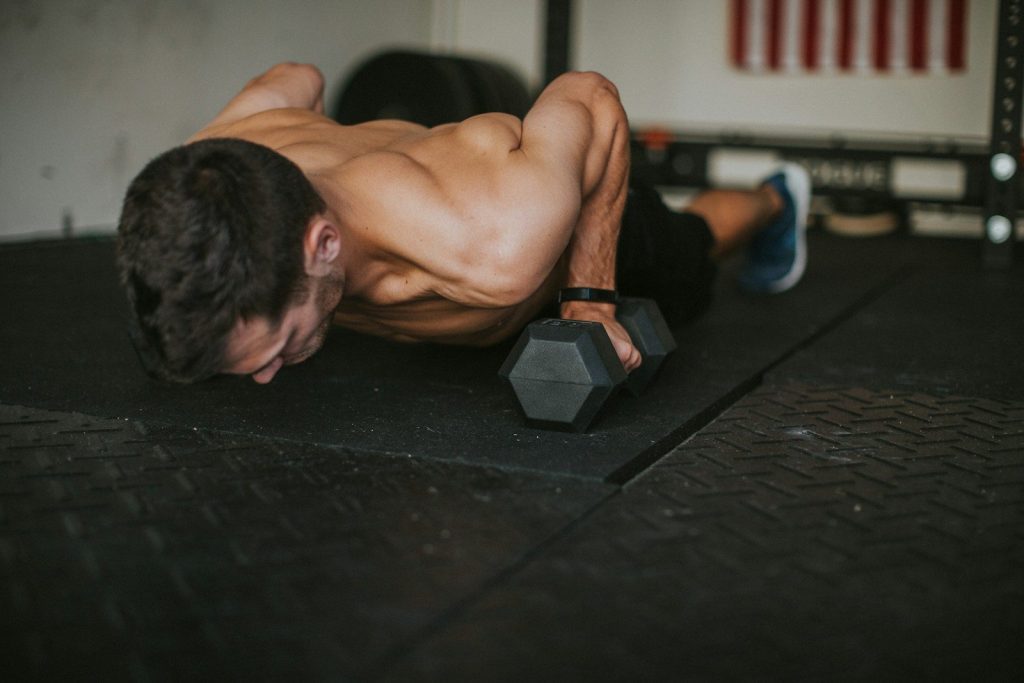
This guide includes presses, fly variations, single-arm movements, and no-bench options. You do not need to perform all 12 exercises in one workout. Choose two or three movements that match your equipment, experience, and training goal.
12 Best Dumbbell Chest Exercises at a Glance
| Exercise | Best for | Equipment | Suggested range | |
|---|---|---|---|---|
| 1 | Flat dumbbell bench press | Overall chest strength and muscle | Dumbbells and flat bench | 3–4 sets of 5–10 reps |
| 2 | Low-incline dumbbell bench press | Upper-chest emphasis | Dumbbells and adjustable bench | 3–4 sets of 6–12 reps |
| 3 | Decline dumbbell bench press | Pressing from a decline angle | Dumbbells and decline bench | 2–4 sets of 6–12 reps |
| 4 | Neutral-grip dumbbell bench press | A more tucked pressing position | Dumbbells and bench | 2–4 sets of 8–12 reps |
| 5 | Single-arm dumbbell bench press | Unilateral strength and trunk control | One dumbbell and flat bench | 2–3 sets of 8–12 reps per side |
| 6 | Dumbbell floor press | No-bench pressing | Dumbbells and floor space | 3–4 sets of 6–12 reps |
| 7 | Dumbbell squeeze press | Lighter chest accessory work | Dumbbells and bench | 2–3 sets of 10–15 reps |
| 8 | Flat dumbbell fly | Chest isolation after pressing | Dumbbells and flat bench | 2–3 sets of 10–15 reps |
| 9 | Incline dumbbell fly | Upper-chest accessory work | Dumbbells and adjustable bench | 2–3 sets of 10–15 reps |
| 10 | Dumbbell fly-to-press | Combined fly and press training | Dumbbells and flat bench | 2–3 sets of 8–12 reps |
| 11 | Dumbbell deficit push-up | Bodyweight chest training with added range | Stable hex dumbbells | 2–4 sets of 6–15 reps |
| 12 | Dumbbell pullover | Chest and upper-body accessory work | One dumbbell and bench | 2–3 sets of 8–15 reps |
What Muscles Do Dumbbell Chest Exercises Work?
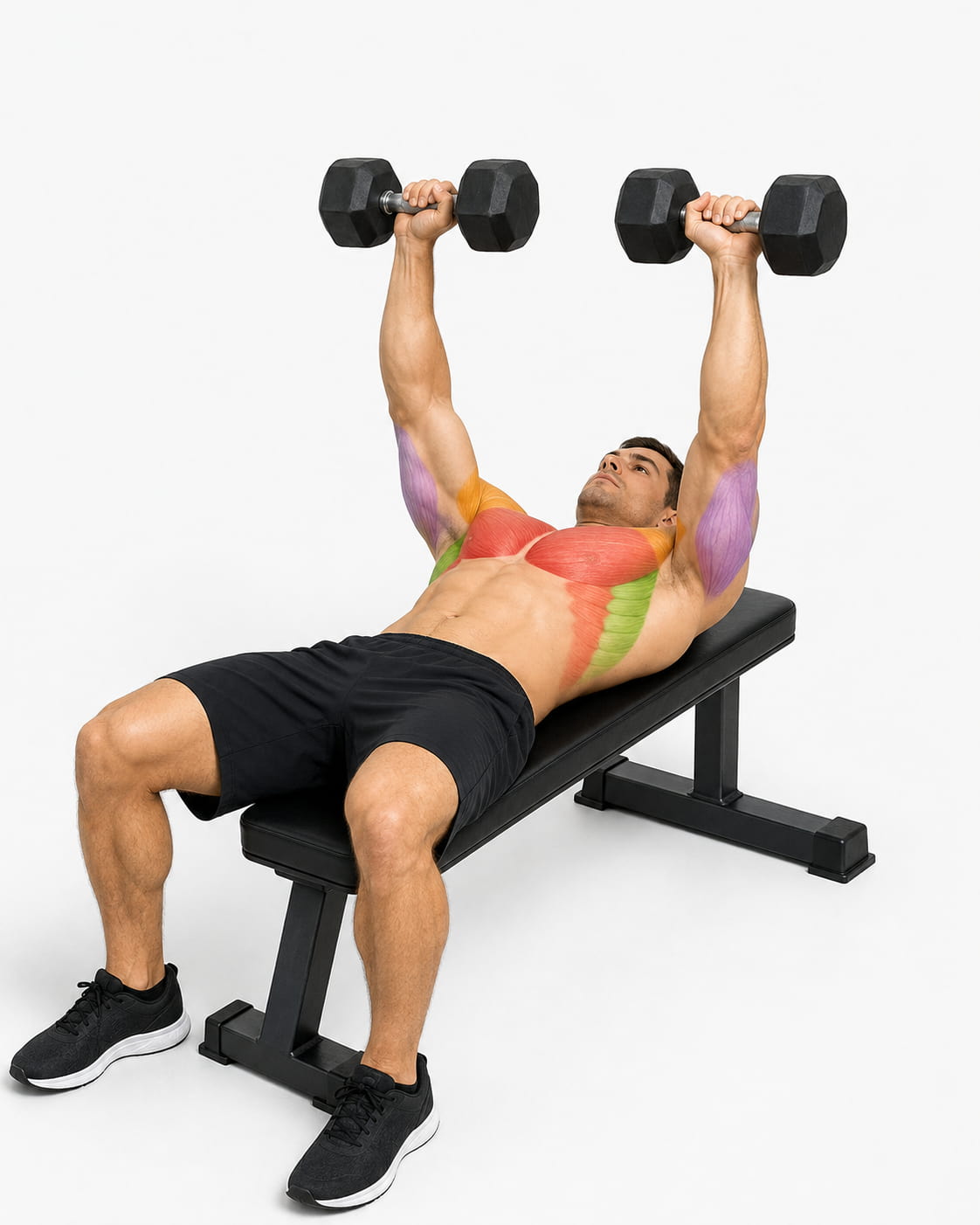
The main muscle trained is the pectoralis major, which covers the front of the chest and helps move the upper arm forward and across the body.
The clavicular portion is commonly called the upper chest, while the sternocostal portion makes up most of the middle and lower chest area.
Other muscles involved include:
- Anterior deltoids: Help move the arms forward.
- Triceps: Straighten the elbows during presses.
- Serratus anterior: Helps control the shoulder blades.
- Rotator cuff and upper back: Stabilize the shoulders.
- Core muscles: Help control the torso, especially during single-arm exercises.
Bench angle can place more emphasis on certain chest fibers, but no exercise completely isolates the “inner,” “upper,” or “lower” chest.
How to Choose Your Dumbbell Chest Exercises
A complete workout usually needs only three movements:
- Choose one main press, such as the flat dumbbell bench press or floor press.
- Add a different pressing angle, such as a low-incline press.
- Finish with a lighter accessory, such as a fly or squeeze press.
Add a fourth exercise only when you have enough training experience and can recover from the additional work.
Perform presses before flyes because presses allow you to use more weight and train the chest, shoulders, and triceps together. Flyes, squeeze presses, and pullovers generally work better near the end of the session.
For incline exercises, begin with the bench set to approximately 15–30 degrees. A steeper angle usually shifts more work toward the front of the shoulders.
Before Starting Your Dumbbell Chest Workout
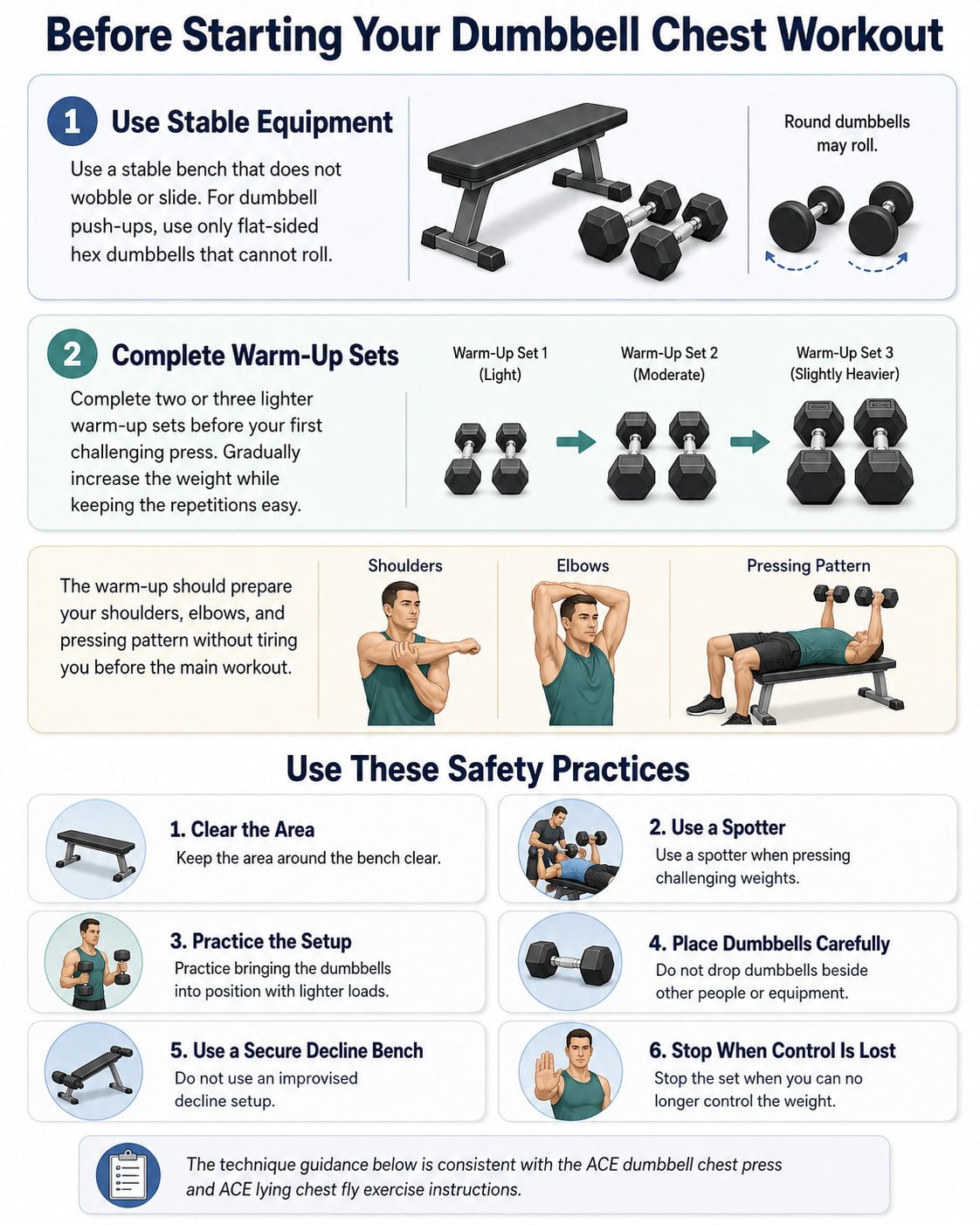
Complete two or three lighter warm-up sets before your first challenging press. Gradually increase the weight while keeping the repetitions easy and controlled.
Use these basic safety practices:
- Train on a stable bench that does not wobble or slide.
- Use only flat-sided hex dumbbells for dumbbell push-ups.
- Keep the area around the bench clear.
- Practice getting the dumbbells into position with lighter weights.
- Use a spotter when pressing challenging loads.
- Do not use an improvised decline setup.
- Stop the set when you can no longer control the weight or maintain proper form.
12 Best Dumbbell Chest Exercises for Strength and Muscle
These 12 dumbbell chest exercises include presses, fly variations, unilateral movements, and no-bench options for building strength and muscle. Choose two or three exercises that match your equipment and training level instead of performing all 12 in one workout.
1. Flat Dumbbell Bench Press
Best for: Building overall chest strength and muscle.
Muscles worked: Pectoralis major, anterior deltoids, and triceps.
Equipment needed: Two dumbbells and a stable flat bench.
Sets, reps, and rest: Perform 3–4 sets of 5–10 repetitions. Rest 90–180 seconds.
How to Do It
- Sit on the end of the bench with one dumbbell resting on each thigh.
- Lie back while using your legs to guide the dumbbells into position.
- Plant your feet and keep your head, upper back, and hips supported.
- Hold the dumbbells above your chest with your wrists stacked over your forearms.
- Lower the weights under control while keeping your elbows approximately 30–60 degrees from your torso.
- Stop at a comfortable depth.
- Press the dumbbells upward without banging them together.
Common mistakes: Letting the wrists bend backward, flaring the elbows directly sideways, bouncing out of the bottom, lifting the feet, or exaggerating the lower-back arch.
Progression or regression: Use lighter dumbbells or perform the floor press as a regression. Progress by reaching the top of your repetition range before increasing the weight.
Coaching cue: Keep your forearms vertical beneath the dumbbells.
2. Low-Incline Dumbbell Bench Press
Best for: Adding more emphasis to the upper portion of the chest.
Muscles worked: Pectoralis major, anterior deltoids, and triceps.
Equipment needed: Two dumbbells and an adjustable bench.
Sets, reps, and rest: Perform 3–4 sets of 6–12 repetitions. Rest 90–150 seconds.
How to Do It
- Set the bench to approximately 15–30 degrees.
- Bring the dumbbells into position above your upper chest.
- Plant your feet firmly on the floor.
- Keep your shoulder blades gently set against the bench.
- Lower the dumbbells toward your upper chest with your elbows beneath your wrists.
- Press upward and slightly inward until your arms are extended.
Common mistakes: Setting the bench too steep, lowering the dumbbells toward the neck, shrugging the shoulders, or allowing the wrists to fold backward.
Progression or regression: Use a flat press if the incline position is difficult to control. Progress by adding repetitions before increasing the weight.
3. Decline Dumbbell Bench Press
Best for: Adding a decline pressing angle to an established chest program.
Muscles worked: Pectoralis major, anterior deltoids, and triceps.
Equipment needed: Two dumbbells and a secure decline bench with leg support.
Sets, reps, and rest: Perform 2–4 sets of 6–12 repetitions. Rest 90–150 seconds.
How to Do It
- Secure your legs beneath the bench pads before handling the dumbbells.
- Lie back and position the weights above your lower-to-middle chest.
- Keep your wrists straight and your shoulder blades stable.
- Lower the dumbbells under control.
- Stop when you reach a comfortable depth.
- Press the dumbbells upward without allowing your shoulders to roll forward.
Common mistakes: Using an improvised decline setup, choosing an excessively steep angle, lowering too deeply, or trying to sit up while holding heavy dumbbells.
Progression or regression: Use the flat dumbbell bench press as a simpler alternative. Ask for a spotter when moving heavier dumbbells into or out of position.
4. Neutral-Grip Dumbbell Bench Press
Best for: Readers who prefer a palms-facing grip and a more tucked elbow position.
Muscles worked: Pectoralis major, triceps, and anterior deltoids.
Equipment needed: Two dumbbells and a flat or slightly inclined bench.
Sets, reps, and rest: Perform 2–4 sets of 8–12 repetitions. Rest 75–120 seconds.
How to Do It
- Lie on the bench with the dumbbells above your chest.
- Turn your palms toward each other.
- Keep your elbows closer to your sides than during a standard press.
- Lower the weights until your upper arms reach a comfortable position.
- Press upward while maintaining the neutral grip.
Common mistakes: Allowing the dumbbells to drift toward the waist, bending the wrists, or forcing the elbows tightly against the ribs.
Progression or regression: Begin with a semi-neutral grip, with the palms turned slightly forward. Progress by adding repetitions or weight while maintaining the same pressing path.
5. Single-Arm Dumbbell Bench Press
Best for: Training one side at a time while challenging trunk stability.
Muscles worked: Pectoralis major, triceps, anterior deltoids, abdominals, and spinal stabilizers.
Equipment needed: One dumbbell and a flat bench.
Sets, reps, and rest: Perform 2–3 sets of 8–12 repetitions per side. Rest 75–120 seconds.
How to Do It
- Lie on the bench with your feet wider than hip-width for stability.
- Hold one dumbbell above your chest.
- Brace your trunk and keep both shoulders and hips against the bench.
- Lower the dumbbell beside your chest.
- Press it upward while resisting the urge to rotate.
- Complete all repetitions before switching sides.
Common mistakes: Twisting the torso, lifting one side of the hips, rushing the repetitions, or using a weight that prevents stable positioning.
Progression or regression: Regress to an alternating dumbbell press while holding two weights. Progress only when your torso remains stable throughout every repetition.
6. Dumbbell Floor Press
Best for: Chest pressing without a bench or using a shorter bottom range of motion.
Muscles worked: Pectoralis major, triceps, and anterior deltoids.
Equipment needed: Two dumbbells and clear floor space.
Sets, reps, and rest: Perform 3–4 sets of 6–12 repetitions. Rest 90–150 seconds.
How to Do It
- Sit on the floor with the dumbbells beside your thighs.
- Lie back carefully with your knees bent and feet planted.
- Position the dumbbells above your chest with your wrists straight.
- Lower them until the backs of your upper arms gently touch the floor.
- Pause briefly.
- Press the dumbbells upward.
Common mistakes: Slamming the elbows into the floor, lifting the hips, flaring the elbows excessively, or losing control while getting into position.
Progression or regression: Reduce the weight or press one dumbbell at a time. Progress to a flat bench press when you can control a longer range of motion.
7. Dumbbell Squeeze Press
Best for: A lighter accessory exercise that adds continuous inward pressure.
Muscles worked: Pectoralis major, triceps, and anterior deltoids.
Equipment needed: Two dumbbells and a bench.
Sets, reps, and rest: Perform 2–3 sets of 10–15 repetitions. Rest 60–90 seconds.
How to Do It
- Lie on the bench with the dumbbells together above your chest.
- Hold the weights with your palms facing each other.
- Press the dumbbells firmly together.
- Lower them toward your chest while maintaining inward pressure.
- Press back upward while continuing to squeeze the dumbbells together.
Common mistakes: Letting the weights separate, using more weight than you can control, shortening the movement excessively, or pushing one dumbbell harder than the other.
Progression or regression: Start with light dumbbells. Progress by adding repetitions, slowing the lowering phase, or increasing the weight slightly.
8. Flat Dumbbell Fly
Best for: Adding chest-focused isolation after compound presses.
Muscles worked: Pectoralis major, anterior deltoids, and shoulder stabilizers.
Equipment needed: Two light dumbbells and a flat bench.
Sets, reps, and rest: Perform 2–3 sets of 10–15 repetitions. Rest 60–90 seconds.
How to Do It
- Lie on the bench with the dumbbells above your chest.
- Turn your palms toward each other.
- Keep a small bend in your elbows.
- Open your arms in a wide arc while maintaining approximately the same elbow angle.
- Stop when your upper arms are near torso level or you feel a comfortable chest stretch.
- Bring the dumbbells back together through the same arc.
Common mistakes: Turning the exercise into a press, using heavy weights, lowering too far, or straightening the elbows completely.
Progression or regression: Use lighter weights or a smaller range. Progress by slowing the lowering phase before increasing the load.
9. Incline Dumbbell Fly
Best for: A lighter accessory movement performed from an incline angle.
Muscles worked: Pectoralis major, with assistance from the anterior deltoids.
Equipment needed: Two light dumbbells and an adjustable bench.
Sets, reps, and rest: Perform 2–3 sets of 10–15 repetitions. Rest 60–90 seconds.
How to Do It
- Set the bench to approximately 15–30 degrees.
- Hold the dumbbells above your upper chest with your palms facing each other.
- Maintain a small bend in your elbows.
- Lower the dumbbells in an arc until you reach a comfortable stretch.
- Bring your arms back together without banging the weights.
Common mistakes: Using a steep incline, lowering too deeply, repeatedly changing the elbow angle, or choosing the same weight used for pressing.
Progression or regression: Begin with a flat fly or use a shorter range. Progress by adding controlled repetitions before increasing the weight.
10. Dumbbell Fly-to-Press
Best for: Combining a controlled fly with a stronger pressing movement.
Muscles worked: Pectoralis major, anterior deltoids, and triceps.
Equipment needed: Two light dumbbells and a flat bench.
Sets, reps, and rest: Perform 2–3 sets of 8–12 repetitions. Rest 75–120 seconds.
How to Do It
- Begin with the dumbbells above your chest and your palms facing each other.
- Lower the weights in a fly arc with a slight elbow bend.
- At the bottom, bend your elbows and move the dumbbells into a chest-press position.
- Press the weights upward.
- Reset your grip and elbow position before beginning the next repetition.
Common mistakes: Using heavy weights, dropping quickly into the fly, moving unevenly through the transition, or lowering beyond a controllable range.
Progression or regression: Practice the press and fly separately before combining them. Progress with smoother transitions rather than large weight increases.
11. Dumbbell Deficit Push-Up
Best for: Chest training without a bench and progressing beyond a standard floor push-up.
Muscles worked: Pectoralis major, triceps, anterior deltoids, serratus anterior, and core muscles.
Equipment needed: Two stable, flat-sided hex dumbbells.
Sets, reps, and rest: Perform 2–4 sets of 6–15 repetitions. Rest 60–120 seconds.
How to Do It
- Place two hex dumbbells slightly wider than shoulder-width apart.
- Grip the handles and step your feet back into a straight-body plank.
- Brace your abdomen and keep your head aligned with your spine.
- Lower your chest between the dumbbells only as far as you can control.
- Push the floor away and return to the starting position.
Common mistakes: Using round dumbbells that can roll, allowing the hips to sag, flaring the elbows directly sideways, or forcing an excessively deep range.
Progression or regression: Regress to a standard floor push-up or place the dumbbells on a stable elevated surface. Progress by adding repetitions, slowing the lowering phase, or elevating your feet.
12. Dumbbell Pullover
Best for: Finishing a chest or upper-body workout with a shoulder-extension accessory.
Muscles worked: Pectoralis major, latissimus dorsi, long head of the triceps, serratus anterior, and trunk stabilizers.
Equipment needed: One dumbbell and a flat bench.
Sets, reps, and rest: Perform 2–3 sets of 8–15 repetitions. Rest 60–90 seconds.
How to Do It
- Lie lengthwise on a bench with your feet planted.
- Hold one dumbbell securely with both hands above your chest.
- Keep a small bend in your elbows.
- Brace your abdomen and keep your ribs controlled.
- Lower the dumbbell behind your head until your upper arms approach your ears or you reach a comfortable range.
- Pull the dumbbell back above your chest without increasing your lower-back arch.
Common mistakes: Lowering too far, allowing the ribs to flare, turning the movement into a triceps extension, or using an insecure grip.
Progression or regression: Perform the movement on the floor for a shorter range or use a lighter dumbbell. Increase the range gradually without forcing your shoulders.
The dumbbell pullover trains both the chest and back. It is better used near the end of a workout than as your primary chest exercise.
How to Choose the Right Dumbbell Weight
Choose a weight that allows you to complete every planned repetition without:
- Bending your wrists backward
- Bouncing or using momentum
- Shortening the movement unexpectedly
- Losing contact with the bench
- Twisting from side to side
- Holding your breath throughout the set
For most muscle-building sets, finish with approximately 1–3 repetitions in reserve. This means you could perform one to three additional controlled repetitions before reaching failure.
Use these general repetition ranges:
- Main presses: 5–10 reps
- Secondary presses: 8–12 reps
- Flyes and squeeze presses: 10–15 reps
- Push-ups: Stop before your body position begins to break down
A simple progression method is to add repetitions before adding weight.
For example, when your target range is 8–12 repetitions, keep the same weight until you can complete 12 controlled repetitions in every set. Then increase the weight slightly and begin near the lower end of the range again.
How Many Weekly Chest Sets Should You Perform?
A practical starting point is approximately 6–10 direct chest sets per week.
More experienced lifters may use approximately 10–14 weekly sets when their performance, recovery, and technique remain good.
The American College of Sports Medicine resistance-training guidance emphasizes consistent training, individualized programming, and approximately 10 weekly sets per muscle group as a general muscle-growth target.
You do not need to train to complete failure during every set. Most sets can end with approximately 1–3 controlled repetitions remaining.
Remember that shoulder presses, push-ups, dips, and other pressing exercises may also add stress to your chest, shoulders, and triceps.
Sample Dumbbell Chest Workouts
Beginner Dumbbell Chest Workout
Perform this workout one or two times per week.
| Exercise | Sets | Reps | Rest |
|---|---|---|---|
| Flat dumbbell bench press | 2 | 8–12 | 90–120 seconds |
| Low-incline dumbbell bench press | 2 | 8–12 | 90 seconds |
| Dumbbell squeeze press | 2 | 12–15 | 60–90 seconds |
Use a weight that leaves approximately 2–3 repetitions in reserve.
Add repetitions before increasing the dumbbell weight.
Strength and Muscle Dumbbell Chest Workout
Perform this workout once per week or divide the exercises between two upper-body sessions.
| Exercise | Sets | Reps | Rest |
|---|---|---|---|
| Flat dumbbell bench press | 3 | 5–8 | 2–3 minutes |
| Low-incline dumbbell bench press | 3 | 8–12 | 90–150 seconds |
| Flat dumbbell fly | 2 | 10–15 | 60–90 seconds |
Keep approximately 1–3 repetitions in reserve.
When every set reaches the top of the target range with controlled form, increase the weight slightly.
No-Bench Dumbbell Chest Workout
Perform this workout one or two times per week.
| Exercise | Sets | Reps | Rest |
|---|---|---|---|
| Dumbbell floor press | 3 | 8–12 | 90–120 seconds |
| Dumbbell deficit push-up | 2–3 | 6–15 | 60–120 seconds |
| Floor dumbbell pullover | 2 | 10–15 | 60–90 seconds |
Use standard floor push-ups instead of deficit push-ups when you cannot control the additional range.
Common Dumbbell Chest Training Mistakes
Performing Too Many Similar Exercises
Flat presses, neutral-grip presses, squeeze presses, and single-arm presses are useful, but they do not all need to appear in the same workout.
Choose exercises that serve different purposes rather than repeating nearly identical movements.
Setting the Incline Too High
A steep incline moves the exercise closer to a shoulder press.
Begin near 15–30 degrees when the goal is upper-chest training.
Using Pressing Weights for Flyes
Flyes place the dumbbells farther from the shoulder joint, making the movement challenging even with lighter weights.
Use substantially less weight than you would use for a chest press.
Lowering Beyond Your Controllable Range
More range is not automatically better.
Stop when you feel a manageable chest stretch and can keep your shoulders, wrists, and torso stable.
Letting the Wrists Bend Backward
Keep the dumbbell handles stacked over your forearms.
A bent wrist makes the pressing position less stable and may limit how much weight you can control.
Progressing Only by Adding Weight
You can also progress by:
- Adding repetitions
- Improving movement control
- Increasing the range gradually
- Adding one set
- Slowing the lowering phase
- Reducing unnecessary momentum
Ignoring the Setup and Finish
Many problems occur while moving heavy dumbbells into or out of position.
Practice the setup with light weights and use a spotter when appropriate.
How Often Should You Train Your Chest?
Training your chest approximately two times per week works well for many people because it allows weekly volume to be divided between shorter sessions.
Leave at least one day between challenging chest workouts. You may need more recovery when your program also includes heavy shoulder presses, dips, push-ups, or triceps training.
Reduce the workload when:
- Your pressing strength repeatedly decreases
- Your shoulders or elbows remain unusually uncomfortable
- Muscle soreness affects normal movement
- Your form breaks down with weights you normally control
- You feel unable to recover before the next session
Frequently Asked Questions
What is the best dumbbell chest exercise?
The flat dumbbell bench press is the best general starting point because it allows progressive loading and trains the chest, shoulders, and triceps together.
The dumbbell floor press is a strong alternative when a bench is unavailable.
Can you build your chest using only dumbbells?
Yes. Dumbbells can provide enough resistance to build chest strength and muscle when your sets are challenging and you gradually increase the repetitions, weight, sets, or range of motion.
Can you perform dumbbell chest exercises without a bench?
Yes. Useful options include:
- Dumbbell floor press
- Floor squeeze press
- Floor dumbbell pullover
- Standard push-up
- Push-up using stable hex dumbbells
What is the best dumbbell exercise for the upper chest?
The low-incline dumbbell bench press is the most practical primary choice.
Set the bench to approximately 15–30 degrees and avoid turning the movement into a steep shoulder press.
How many chest exercises should you perform in one workout?
Most people need two to four exercises.
One main press, one secondary press, and one accessory movement are enough for a complete dumbbell chest workout.
Are dumbbell flyes necessary?
No. Your chest can grow without flyes when your pressing program provides enough challenging training volume.
Flyes are an optional accessory that provides a different arm path and places less emphasis on elbow extension.
Should the dumbbells touch at the top of a chest press?
The dumbbells can move slightly toward each other, but they do not need to collide.
Maintain control and keep your shoulders stable instead of forcing the weights together.
Conclusion
The best dumbbell chest workout is built around a small number of well-performed exercises.
Start with a flat bench press or floor press, add a low-incline variation, and finish with one controlled accessory movement.
Keep your wrists stable, use a comfortable elbow angle, and stop each repetition before your position begins to break down. Progress by improving your repetitions and control before making large increases in weight.
Stop exercising and seek professional help if you experience sharp pain, numbness, dizziness, chest pain, or other unusual symptoms.
This content is for informational purposes only and is not a substitute for professional medical advice.
References
- American College of Sports Medicine: Updated Resistance Training Guidelines
- NCBI Bookshelf: Anatomy of the Pectoralis Major
- Comparison of Dumbbell, Barbell, and Smith-Machine Chest Presses
- Effect of Five Bench Inclinations on Upper-Body Muscle Activity
- Bench Press Versus Dumbbell Fly Muscle Activation
- Pectoralis Major and Latissimus Dorsi Activity During the Dumbbell Pullover
1 thought on “12 Best Dumbbell Chest Exercises for Strength and Muscle”