The best dumbbell exercises train every major muscle group through a balanced mix of squatting, hinging, pushing, pulling, carrying, and single-leg movements. With one pair of dumbbells, you can build a practical full-body workout at home or in the gym.
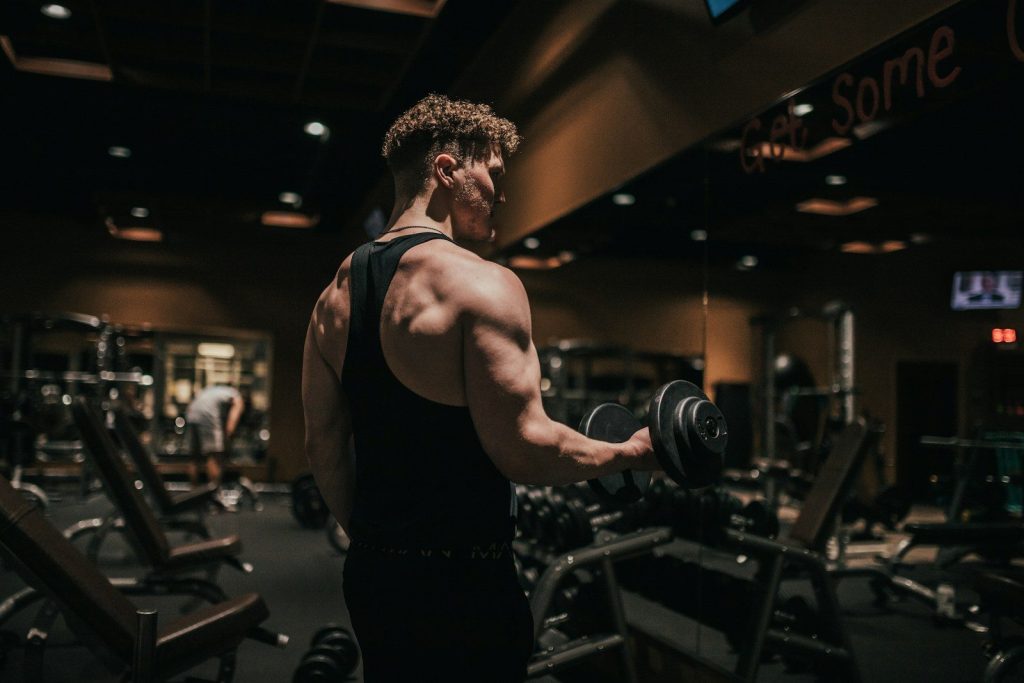
You do not need to perform all 15 exercises in one session. Choose movements that cover the major patterns, use a weight you can control, and progress gradually as your technique and strength improve.
The American College of Sports Medicine’s updated resistance-training guidance emphasizes consistency over complicated programming. Training all major muscle groups at least twice per week matters more for most adults than using advanced routines or taking every set to muscular failure.
Why Dumbbell Exercises Work for Full-Body Training
Dumbbells can train your legs, glutes, chest, back, shoulders, arms, and core with relatively little equipment. Because each side supports its own weight, they also make unilateral training easy and can help you notice side-to-side differences in strength or control.
A well-designed dumbbell program can help you:
- Build strength and muscle
- Improve coordination and movement control
- Train effectively at home or in the gym
- Progress by adding weight, repetitions, sets, pauses, or range of motion
Current US physical activity guidelines recommend muscle-strengthening activity for all major muscle groups on at least two days per week.
15 Best Dumbbell Exercises at a Glance
| Exercise | Movement | Primary muscles | |
|---|---|---|---|
| 1 | Goblet squat | Squat | Quadriceps, glutes |
| 2 | Romanian deadlift | Hip hinge | Hamstrings, glutes |
| 3 | Reverse lunge | Single-leg squat | Quadriceps, glutes |
| 4 | Step-up | Single-leg strength | Quadriceps, glutes |
| 5 | Glute bridge | Hip extension | Glutes, hamstrings |
| 6 | Standing calf raise | Ankle extension | Calves |
| 7 | Dumbbell bench press | Horizontal push | Chest, triceps, shoulders |
| 8 | One-arm dumbbell row | Horizontal pull | Lats, upper back, biceps |
| 9 | Dumbbell shoulder press | Vertical push | Shoulders, triceps |
| 10 | Dumbbell pullover | Shoulder extension | Lats, chest, serratus anterior |
| 11 | Dumbbell reverse fly | Upper-back isolation | Rear delts, upper back |
| 12 | Hammer curl | Elbow flexion | Biceps, brachialis, forearms |
| 13 | Overhead triceps extension | Elbow extension | Triceps |
| 14 | Dumbbell thruster | Squat and press | Legs, shoulders, triceps |
| 15 | Farmer’s carry | Loaded carry | Grip, core, upper back |
You do not need to perform all 15 exercises in one workout. Choose movements that cover the major patterns and match your experience level, equipment, and goals.
How to Choose the Right Dumbbell Weight
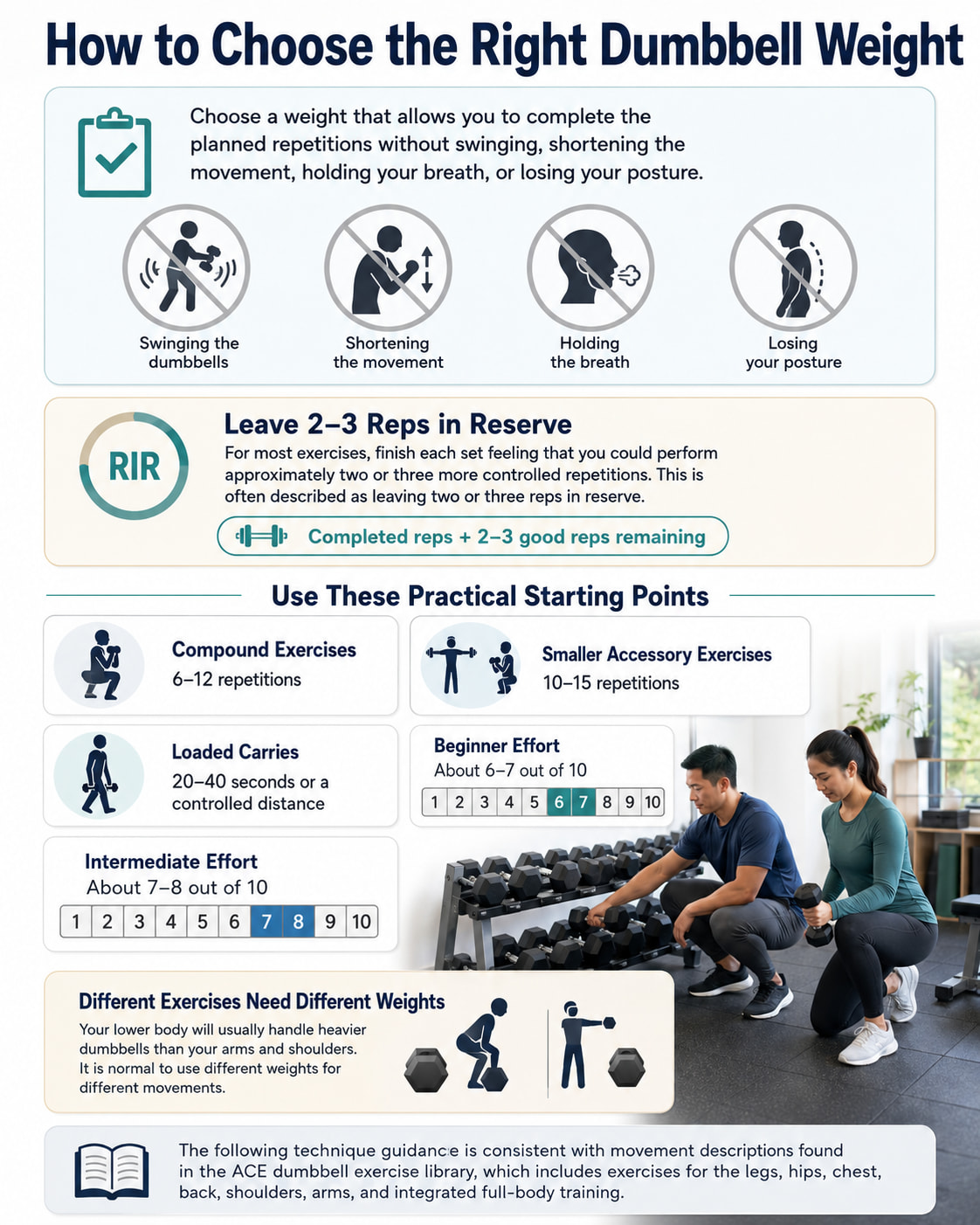
Choose a weight that lets you complete every repetition with controlled form. If you have to swing the dumbbells, shorten the range of motion, or noticeably change your posture, the weight is probably too heavy.
For most sets, aim to finish with about 2–3 good repetitions still in reserve.
Practical starting ranges:
- Compound exercises: 6–12 reps
- Accessory exercises: 10–15 reps
- Loaded carries: 20–40 seconds
- Beginner effort: About 6–7 out of 10
- Intermediate effort: About 7–8 out of 10
Your legs and back will usually handle more weight than smaller muscle groups such as your shoulders and arms, so using different dumbbell weights for different exercises is normal.
The ACE dumbbell exercise library includes dumbbell movements for the legs, hips, chest, back, shoulders, arms, and full-body training.
15 Best Dumbbell Exercises for a Full-Body Workout
These 15 dumbbell exercises target every major muscle group through squats, hinges, presses, rows, lunges, curls, carries, and full-body movements. Choose six to eight exercises per session to build a balanced, effective workout at home or in the gym.
1. Dumbbell Goblet Squat
Best for: Learning the squat pattern and strengthening the lower body with one dumbbell.
Muscles worked: Quadriceps and gluteus maximus, with assistance from the hamstrings, adductors, calves, and core.
Equipment needed: One dumbbell.
Sets, reps, and rest: Perform 2–4 sets of 8–12 repetitions. Rest for 60–120 seconds.
How to do it:
- Hold one end of a dumbbell close to your chest with both hands.
- Stand with your feet approximately shoulder-width apart and your toes turned slightly outward.
- Brace your abdomen and lower your hips between your legs.
- Keep your entire foot in contact with the floor as your knees track in the same direction as your toes.
- Descend as far as you can without your heels lifting or your lower back rounding.
- Push through your feet to stand tall.
Common mistakes: Avoid letting the dumbbell drift away from your chest, allowing your knees to collapse inward, lifting your heels, or forcing a depth you cannot control.
Regression: Squat to a stable chair or bench.
Progression: Use a heavier dumbbell, add a pause at the bottom, or progress to a two-dumbbell front squat.
Coaching cue: Sit between your hips rather than folding forward.
ACE describes the goblet squat as a dumbbell exercise for the hips and thighs performed with the weight held vertically in front of the chest.
2. Dumbbell Romanian Deadlift
Best for: Building hamstring and glute strength while learning a controlled hip hinge.
Muscles worked: Hamstrings and gluteus maximus, with assistance from the adductors, spinal erectors, upper back, forearms, and core.
Equipment needed: Two dumbbells.
Sets, reps, and rest: Perform 2–4 sets of 6–12 repetitions. Rest for 90–120 seconds.
How to do it:
- Stand tall with a dumbbell in each hand in front of your thighs.
- Keep your feet about hip-width apart and soften your knees slightly.
- Brace your core and push your hips backward.
- Let the dumbbells travel close to your legs as your torso leans forward.
- Stop when you feel strong hamstring tension or before your back begins to round.
- Drive your hips forward and return to standing.
Common mistakes: Do not turn the movement into a squat by bending your knees excessively. Avoid reaching the dumbbells toward the floor, rounding your back, or leaning backward at the top.
Regression: Use one dumbbell or reduce the range of motion.
Progression: Increase the weight, slow the lowering phase, or use a staggered-stance Romanian deadlift.
Coaching cue: Close an imaginary car door with your hips.
3. Dumbbell Reverse Lunge
Best for: Developing single-leg strength, balance, and lower-body control.
Muscles worked: Quadriceps and glutes, with assistance from the hamstrings, adductors, calves, and core.
Equipment needed: One or two dumbbells.
Sets, reps, and rest: Perform 2–3 sets of 6–12 repetitions per leg. Rest for 60–90 seconds.
How to do it:
- Stand tall with a dumbbell in each hand.
- Step one foot backward and land on the ball of that foot.
- Lower your body by bending both knees while keeping your front foot flat.
- Keep your front knee tracking over your toes and your torso comfortably upright.
- Push through the front foot to return to standing.
- Complete all repetitions on one side or alternate legs.
Common mistakes: Avoid taking an excessively short step, wobbling onto the outside of the front foot, pushing mainly from the rear leg, or rushing the return to standing.
Regression: Hold one dumbbell at your chest and use a wall or sturdy support for balance.
Progression: Increase the weight or add a knee drive as you return to standing.
Coaching cue: Let the front leg do most of the work.
4. Dumbbell Step-Up
Best for: Building practical single-leg strength for climbing stairs and other daily movements.
Muscles worked: Quadriceps and glutes, with assistance from the hamstrings, calves, hip stabilizers, and core.
Equipment needed: Dumbbells and a stable step, box, or bench.
Sets, reps, and rest: Perform 2–3 sets of 8–12 repetitions per leg. Rest for 60–90 seconds.
How to do it:
- Stand facing a stable platform with a dumbbell in each hand.
- Place your entire working foot on the platform.
- Lean forward only slightly and push through the elevated foot.
- Stand fully on the platform without forcefully pushing from the trailing leg.
- Step down slowly and under control.
- Repeat on the same leg or alternate sides.
Common mistakes: Avoid using a platform that is too high, allowing the working knee to collapse inward, bouncing off the lower foot, or dropping quickly on the way down.
Regression: Use a lower step and perform the exercise without dumbbells.
Progression: Increase the load or use a slightly higher platform while maintaining control.
Coaching cue: Pull yourself onto the step with the top leg.
5. Dumbbell Glute Bridge
Best for: Training hip extension without placing a heavy load on the spine.
Muscles worked: Gluteus maximus, with assistance from the hamstrings, adductors, and core.
Equipment needed: One dumbbell and an exercise mat.
Sets, reps, and rest: Perform 2–4 sets of 10–15 repetitions. Rest for 60–90 seconds.
How to do it:
- Lie on your back with your knees bent and feet flat.
- Place a dumbbell securely across the front of your hips and hold it with both hands.
- Gently brace your abdomen and press through your feet.
- Lift your hips until your shoulders, hips, and knees form a roughly straight line.
- Pause briefly while squeezing your glutes.
- Lower your hips under control.
Common mistakes: Avoid pushing your hips so high that your lower back arches, placing your feet too far away, or driving mainly through your toes.
Regression: Perform the bridge without weight.
Progression: Use a heavier dumbbell, add a longer pause, or perform a single-leg bridge without weight.
Coaching cue: Finish with your glutes, not your lower back.
6. Dumbbell Standing Calf Raise
Best for: Strengthening the calves and improving control at the ankle.
Muscles worked: Gastrocnemius and soleus, with the foot and ankle muscles assisting.
Equipment needed: One or two dumbbells.
Sets, reps, and rest: Perform 2–4 sets of 10–20 repetitions. Rest for 45–75 seconds.
How to do it:
- Stand tall with your feet approximately hip-width apart.
- Hold the dumbbells at your sides.
- Keep your knees straight but not forcefully locked.
- Rise onto the balls of your feet as high as you can control.
- Pause briefly at the top.
- Lower your heels slowly to the floor.
Common mistakes: Avoid bouncing, rolling onto the outside edges of your feet, rushing the lowering phase, or leaning forward.
Regression: Hold one dumbbell and use your free hand for support.
Progression: Perform the exercise one leg at a time or stand on a step for a greater controlled range of motion.
Coaching cue: Rise straight upward through your big toes.
7. Dumbbell Bench Press
Best for: Building chest and pressing strength with independent loading for each arm.
Muscles worked: Pectoralis major, triceps, and anterior deltoids.
Equipment needed: Two dumbbells and a flat bench.
Sets, reps, and rest: Perform 2–4 sets of 6–12 repetitions. Rest for 90–120 seconds.
How to do it:
- Sit on the bench with a dumbbell resting on each thigh.
- Lie back carefully and position the dumbbells beside your chest.
- Plant your feet firmly and keep your head, upper back, and hips supported.
- Hold your elbows at a comfortable angle below shoulder level.
- Press the dumbbells upward until your arms are extended without forcefully locking your elbows.
- Lower the dumbbells under control until you reach a comfortable depth.
Common mistakes: Avoid flaring your elbows directly outward, bouncing at the bottom, lifting your hips, bending your wrists backward, or letting the dumbbells collide at the top.
Regression: Perform a dumbbell floor press to limit the bottom range.
Progression: Increase the weight or use a slight pause near the bottom.
Coaching cue: Press up while keeping your shoulders supported by the bench.
The ACE chest-press guide identifies the chest, shoulders, and arms as the main target areas and emphasizes stable foot and spinal positioning on the bench.
8. One-Arm Dumbbell Row
Best for: Strengthening the back while using a stable, supported position.
Muscles worked: Latissimus dorsi, rhomboids, trapezius, posterior deltoids, and biceps.
Equipment needed: One dumbbell and a bench or sturdy support.
Sets, reps, and rest: Perform 2–4 sets of 8–15 repetitions per arm. Rest for 60–90 seconds.
How to do it:
- Place one hand on a bench or sturdy surface.
- Step into a stable staggered stance and hinge forward at your hips.
- Hold the dumbbell beneath your shoulder with your free hand.
- Keep your spine neutral and your shoulders approximately level.
- Pull your elbow toward your hip.
- Lower the dumbbell until your arm is extended without twisting your torso.
Common mistakes: Avoid shrugging the working shoulder, rotating your body to lift the weight, jerking the dumbbell, or pulling the elbow far behind your torso.
Regression: Use a lighter dumbbell and support both your hand and knee on a bench.
Progression: Increase the load or add a pause when the dumbbell reaches your torso.
Coaching cue: Lead the pull with your elbow.
9. Dumbbell Shoulder Press
Best for: Developing overhead pressing strength in the shoulders and arms.
Muscles worked: Anterior and middle deltoids and triceps, with assistance from the upper chest, upper back, and core.
Equipment needed: Two dumbbells. A bench is optional.
Sets, reps, and rest: Perform 2–4 sets of 6–12 repetitions. Rest for 75–120 seconds.
How to do it:
- Hold the dumbbells near shoulder height.
- Stand with your feet stable or sit against an upright bench.
- Brace your core and keep your ribs stacked over your pelvis.
- Press the dumbbells overhead in a comfortable path.
- Finish with your arms extended without shrugging aggressively.
- Lower the weights slowly to shoulder height.
Common mistakes: Avoid leaning backward, flaring your ribs, pressing the weights too far in front of your body, or using leg drive unless you are intentionally performing a push press.
Regression: Use a seated position and a neutral grip with your palms facing each other.
Progression: Increase the load or alternate arms while maintaining a stable torso.
Coaching cue: Finish tall without arching your lower back.
10. Dumbbell Pullover
Best for: Training the upper body through a large shoulder-extension range.
Muscles worked: Latissimus dorsi, pectoralis major, serratus anterior, and the long head of the triceps.
Equipment needed: One dumbbell and a bench or floor space.
Sets, reps, and rest: Perform 2–3 sets of 8–15 repetitions. Rest for 60–90 seconds.
How to do it:
- Lie on a bench with your feet firmly supported.
- Hold one dumbbell above your chest with both hands.
- Keep a slight, fixed bend in your elbows.
- Slowly lower the dumbbell behind your head.
- Stop before your ribs flare, your lower back arches, or your shoulders become uncomfortable.
- Pull the dumbbell back above your chest.
Common mistakes: Avoid lowering beyond your available shoulder range, bending and straightening your elbows repeatedly, dropping the weight quickly, or using an excessively heavy dumbbell.
Regression: Perform the exercise lying on the floor, which limits the range.
Progression: Add weight gradually or use a slower lowering phase.
Coaching cue: Move from your shoulders while keeping your ribs down.
11. Dumbbell Reverse Fly
Best for: Strengthening the rear shoulders and upper back.
Muscles worked: Posterior deltoids, rhomboids, and middle trapezius, with assistance from the rotator cuff.
Equipment needed: Two light dumbbells.
Sets, reps, and rest: Perform 2–3 sets of 10–15 repetitions. Rest for 45–75 seconds.
How to do it:
- Stand with your feet stable and hold a dumbbell in each hand.
- Hinge forward at your hips while maintaining a neutral spine.
- Let your arms hang with a slight bend in your elbows.
- Raise the dumbbells outward until your upper arms approach torso level.
- Pause briefly without shrugging.
- Lower the dumbbells slowly.
Common mistakes: Avoid using heavy weights, swinging your torso, turning the movement into a row, lifting your shoulders toward your ears, or forcing your arms above a comfortable height.
Regression: Lie face down on a slightly inclined bench for additional support.
Progression: Add a pause at the top before increasing the weight.
Coaching cue: Spread your arms wide rather than pulling the weights backward.
The ACE dumbbell library classifies reverse-fly variations as exercises for the back and shoulders.
12. Dumbbell Hammer Curl
Best for: Training the elbow flexors and forearms with a wrist-friendly neutral grip.
Muscles worked: Biceps brachii, brachialis, brachioradialis, and forearm muscles.
Equipment needed: Two dumbbells.
Sets, reps, and rest: Perform 2–3 sets of 8–15 repetitions. Rest for 45–75 seconds.
How to do it:
- Stand tall with a dumbbell in each hand and your palms facing your thighs.
- Keep your wrists straight and your elbows close to your sides.
- Curl the dumbbells toward your shoulders.
- Stop before your elbows drift substantially forward.
- Squeeze briefly at the top.
- Lower the weights until your arms are extended.
Common mistakes: Avoid swinging your hips, leaning backward, bending your wrists, lifting your shoulders, or dropping the weights quickly.
Regression: Curl one arm at a time or use lighter dumbbells.
Progression: Increase the weight or slow the lowering phase to approximately three seconds.
Coaching cue: Keep your upper arms quiet while your forearms move.
13. Dumbbell Overhead Triceps Extension
Best for: Directly training the triceps, particularly the long head.
Muscles worked: All three heads of the triceps, with the shoulders and core stabilizing the position.
Equipment needed: One dumbbell.
Sets, reps, and rest: Perform 2–3 sets of 8–15 repetitions. Rest for 45–75 seconds.
How to do it:
- Sit or stand while holding one dumbbell securely with both hands.
- Press the dumbbell overhead.
- Keep your upper arms close to your head and your ribs controlled.
- Bend your elbows and lower the weight behind your head.
- Stop at a comfortable depth.
- Straighten your elbows to return the dumbbell overhead.
Common mistakes: Avoid flaring your elbows excessively, arching your lower back, moving your upper arms forward and backward, or choosing a weight you cannot position safely.
Regression: Perform the exercise seated with back support.
Progression: Increase the load gradually or use one lighter dumbbell in each hand.
Coaching cue: Point your elbows forward while the weight moves behind you.
14. Dumbbell Thruster
Best for: Combining lower- and upper-body training in one demanding movement.
Muscles worked: Quadriceps, glutes, shoulders, and triceps, with assistance from the hamstrings, calves, upper chest, and core.
Equipment needed: Two dumbbells.
Sets, reps, and rest: Perform 2–4 sets of 6–10 repetitions. Rest for 90–150 seconds.
How to do it:
- Hold the dumbbells at shoulder height.
- Stand with your feet in a comfortable squat stance.
- Brace your core and lower into a controlled squat.
- Push through the floor and stand forcefully.
- Use the upward momentum from your legs to press the dumbbells overhead.
- Lower the weights to your shoulders before beginning the next repetition.
Common mistakes: Avoid pressing before you begin standing, allowing the knees to collapse inward, arching your lower back overhead, or selecting weights that make the movement slow and unstable.
Regression: Perform a goblet squat followed by a separate two-arm press.
Progression: Increase the dumbbell weight carefully or perform controlled repetitions at a slightly faster pace.
Coaching cue: Drive with your legs, then finish with your arms.
15. Dumbbell Farmer’s Carry
Best for: Training grip, trunk stability, posture, and total-body control.
Muscles worked: Forearms, trapezius, shoulders, core, glutes, quadriceps, hamstrings, and calves.
Equipment needed: Two dumbbells and a clear walking space.
Sets, time, and rest: Perform 2–4 carries lasting 20–40 seconds. Rest for 45–90 seconds.
How to do it:
- Place two dumbbells on the floor beside your feet.
- Hinge or squat down and pick them up with a controlled spine position.
- Stand tall with the dumbbells at your sides.
- Keep your head level, ribs controlled, and shoulders relaxed.
- Walk with smooth, deliberate steps.
- Set the dumbbells down with the same control used to lift them.
Common mistakes: Avoid leaning to one side, shrugging continuously, taking rushed steps, holding your breath, or letting the dumbbells swing.
Regression: Carry lighter weights for a shorter time.
Progression: Increase the weight, distance, or duration without changing your posture.
Coaching cue: Walk tall as though balancing a glass of water on your head.
The NSCA describes loaded carries as whole-body exercises performed by walking with an external load for a set distance or time. They can challenge grip, trunk control, and whole-body stability.
Sample Full-Body Dumbbell Workout
You do not need all 15 movements in one workout. The following routine covers a squat, hinge, single-leg movement, horizontal push, horizontal pull, vertical push, and loaded carry.
Beginner-to-Intermediate Dumbbell Workout
| Exercise | Sets | Reps or time | Rest |
|---|---|---|---|
| Goblet squat | 3 | 8–12 | 75–90 seconds |
| Dumbbell Romanian deadlift | 3 | 8–12 | 90 seconds |
| Dumbbell bench press or floor press | 3 | 8–12 | 75–90 seconds |
| One-arm dumbbell row | 3 | 8–12 per arm | 60–90 seconds |
| Dumbbell reverse lunge | 2 | 8–10 per leg | 60–90 seconds |
| Dumbbell shoulder press | 2 | 8–12 | 75–90 seconds |
| Farmer’s carry | 3 | 20–40 seconds | 60 seconds |
Frequency: Perform the routine two or three times per week on nonconsecutive days.
Effort level: Finish most sets with approximately two or three good repetitions still available.
Warm-up: Spend five to eight minutes performing easy movement and lighter practice sets of the first few exercises.
Beginners can start with two sets of each movement and six exercises per workout. Add the third set only when recovery and technique remain consistent.
How to Progress Your Dumbbell Workout
A simple double-progression system works well for most readers.
For an exercise prescribed for 8–12 repetitions:
- Choose a weight you can perform for approximately eight controlled repetitions.
- Keep the same weight while gradually adding repetitions.
- Once you complete 12 repetitions in every set with good form and two or more repetitions still available, increase the dumbbell weight.
- Return to the lower end of the repetition range and repeat the process.
Use the smallest practical weight increase. A large jump may be appropriate for squats or deadlifts but too difficult for reverse flies, curls, or triceps extensions.
When heavier dumbbells are unavailable, make an exercise harder by:
- Slowing the lowering phase
- Adding a one- or two-second pause
- Increasing the repetitions moderately
- Adding one set
- Using one leg or one arm where appropriate
- Improving the range of motion
- Reducing unnecessary rest slightly
Change only one or two variables at a time so you can tell whether you are actually progressing.
Common Dumbbell Exercise Mistakes
Using the Same Weight for Every Exercise
Your legs and back can usually handle more load than your shoulders and arms. Adjust the dumbbells to match each movement instead of forcing one pair to work for everything.
Prioritizing Weight Over Control
A heavier dumbbell is not useful when you must swing, shorten the range, twist your body, or lose your balance to lift it. Reduce the weight and make every repetition look similar.
Rushing the Lowering Phase
Lowering the dumbbells under control helps maintain positioning and prevents the exercise from becoming a series of uncontrolled drops.
Holding Your Breath for Too Long
Exhale through the difficult part of most repetitions and inhale during the easier return. Brief bracing can be useful during heavier compound exercises, but do not remain breathless throughout a set.
Performing Too Many Exercises
A workout containing six to eight well-chosen movements is usually more practical than attempting all 15. Excessive exercise selection can reduce effort, technique quality, and consistency.
Training Hard Every Day
Resistance training creates fatigue as well as stimulus. Give the muscles you trained time to recover before repeating another demanding full-body session.
Dumbbell Exercise Safety Tips
- Clear enough floor space to move and set the weights down safely.
- Inspect adjustable dumbbells before training and secure all collars or locking mechanisms.
- Pick weights up with a controlled squat or hip hinge rather than rounding your back.
- Use a stable bench, chair, or platform that cannot roll or slide.
- Do not use unstable furniture for step-ups or supported rows.
- Keep dumbbells away from children, pets, and walkways.
- Stop the set when your technique changes noticeably.
- Avoid forcing a joint through a painful range.
- Stop exercising and seek appropriate professional help if you experience sharp pain, numbness, dizziness, chest pain, faintness, or unusual shortness of breath.
People returning to exercise after an injury, operation, long period of inactivity, or significant health concern should obtain individualized guidance from a qualified health professional.
Frequently Asked Questions
Can you build your entire body using only dumbbells?
Yes. Dumbbells can train the legs, glutes, chest, back, shoulders, arms, calves, grip, and core. A balanced routine should include lower-body, pushing, pulling, single-leg, and carrying exercises rather than relying only on curls and presses.
How many dumbbell exercises should I do in one workout?
Most full-body sessions need approximately six to eight exercises. Choose movements that cover the major patterns instead of performing several exercises for the same muscle group.
How often should beginners perform dumbbell exercises?
Two full-body sessions per week are a practical starting point. A third session can be added when technique is reliable and recovery between workouts is comfortable. This frequency also aligns with federal guidance to train all major muscle groups on at least two days per week.
Are dumbbell exercises suitable for beginners?
Yes, provided the exercise, weight, range of motion, and training volume match the person’s current ability. Beginners should learn basic squats, hinges, rows, presses, and carries before adding faster or more complex movements such as thrusters.
Can I do a full-body dumbbell workout without a bench?
Yes. Replace the bench press with a floor press, perform supported rows using a stable chair or countertop, and perform glute bridges and pullovers on the floor. Squats, lunges, deadlifts, curls, shoulder presses, and carries require no bench.
Should I use one dumbbell or two?
Both approaches work. One dumbbell may be easier for goblet squats, glute bridges, pullovers, and overhead triceps extensions. Two dumbbells are usually more practical for deadlifts, presses, lunges, curls, and farmer’s carries.
How long should a full-body dumbbell workout take?
A focused session containing six to eight exercises usually takes approximately 35–60 minutes, depending on the number of sets and rest periods. Completing controlled repetitions is more important than finishing quickly.
Conclusion
The best dumbbell exercises are the ones that help you train every major movement pattern with consistent, controlled technique. Build your workout around a squat, hip hinge, push, pull, single-leg exercise, and carry, then add smaller arm or shoulder movements when they support your goals.
Start with manageable weights, leave a few repetitions in reserve, and progress only when you can complete every set without losing your form.
References
- American College of Sports Medicine: 2026 Resistance Training Guidelines
- US Physical Activity Guidelines for Americans
- ACE Dumbbell Exercise Library
- ACE Goblet Squat Exercise Guide
- ACE Dumbbell Chest Press Exercise Guide
- NSCA Guidance on Loaded Carries
This content is for informational purposes only and is not a substitute for professional medical advice.
7 thoughts on “15 Best Dumbbell Exercises for a Full-Body Workout”